
Marine scientists in British Columbia are optimistic about adopting a new strategy for monitoring whale movements based on a successful initiative in California. In San Francisco Bay, a partnership involving researchers, ferry operators, and the community is using innovative technology to track whales and reduce the risk of vessel strikes.
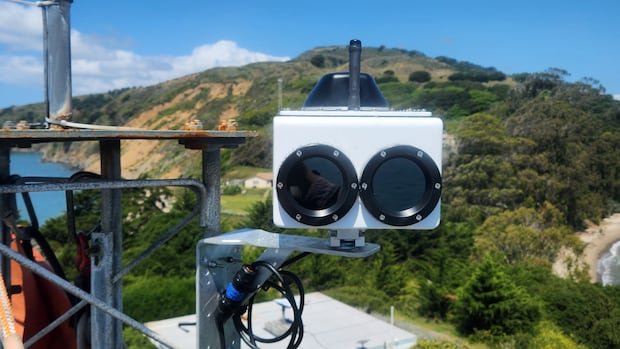
The WhaleSpotter system, featuring specialized cameras that utilize thermal imaging, has been deployed in various locations, including Angel Island and San Francisco Bay Ferry vessels. These cameras, housed in compact white boxes, operate day and night to monitor whale activity. The data collected from these cameras, combined with observations from the public, are accessible through a public app called Whale Safe.
Daniel Zitterbart, the lead scientist at WhaleSpotter, emphasized the importance of increasing surveillance efforts to safeguard whales. While WhaleSpotter cameras are currently stationed on land in British Columbia, their effectiveness is limited compared to the ferry-mounted cameras in California, which have a range of about two nautical miles.
Tracking marine mammals is crucial for understanding their migration patterns and preventing collisions with vessels, a growing concern in British Columbia. Recent incidents, such as the death of a humpback whale in Wright Sound and a humpback calf struck by a ferry, underscore the urgency of addressing this issue.
In San Francisco Bay, the Whale Safe app serves as a collaborative platform for scientists, mariners, researchers, and the public to report and monitor whale sightings. Douglas McCauley, the director of Benioff Ocean Science Laboratory, highlighted the community-driven nature of this initiative, emphasizing its role as a public service resource.
While approved commercial mariners in British Columbia can access WhaleSpotter data through the Ocean Wise whale report alert system, the general public does not have direct access. Thomas Hall from San Francisco Bay Ferry expressed optimism about using ferry-mounted cameras to track whale behavior and adjust routes based on observed patterns.
Zitterbart advocated for the widespread adoption of similar camera systems on all B.C. Ferries routes to enhance whale protection. B.C. Ferries is considering implementing detection devices on its northern route following a fatal incident involving a humpback whale, with plans to expand to other routes in the future.
Efforts to mitigate vessel strikes and protect whales have gained momentum amid increased ship traffic and shifting whale habitats due to climate change. Collaborative initiatives, such as the one in San Francisco Bay, demonstrate the value of shared data and cross-border partnerships in ensuring the safety of marine wildlife.
Conservation experts stress the urgency of addressing vessel strikes as a global issue, requiring coordinated action and information sharing among various stakeholders. Sean Brillant, a conservation biologist at the Canadian Wildlife Federation, emphasized the need for concerted efforts to safeguard whales across borders and regions.

