
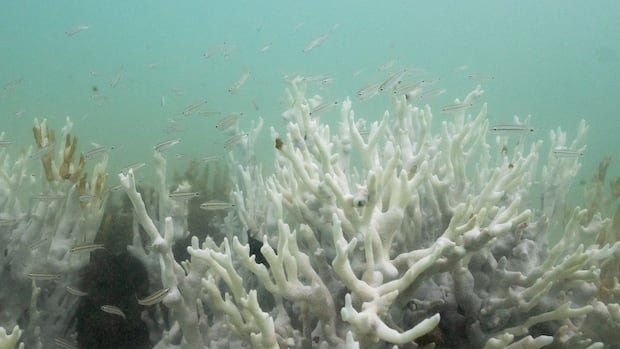
Global warming has reached critical levels sooner than anticipated, leading to a near irreversible decline of coral reefs worldwide, marking a significant “tipping point” in the collapse of ecosystems driven by climate change. The Global Tipping Points report, compiled by 160 researchers globally, highlights the urgency of the situation just ahead of the COP30 climate summit scheduled in Brazil, near the Amazon rainforest.
The report warns that the Amazon rainforest faces the risk of collapse if the global average temperature exceeds 1.5 degrees Celsius, based on current deforestation rates. Another concern is the potential disruption of the Atlantic Meridional Overturning Circulation (AMOC), a key ocean current crucial for maintaining mild winters in northern Europe.
Tim Lenton, an environmental scientist at the University of Exeter and the lead author of the report, emphasized the rapid changes occurring in the climate and biosphere, urging for immediate action. Despite the grim situation, there are positive signals regarding the reduction of fossil fuel usage responsible for climate change. Renewables have surpassed coal in electricity generation for the first time this year, indicating progress in combating climate change.
The scientists are calling on countries participating in COP30 to collaborate in lowering carbon emissions and addressing the climate crisis. Recent data shows that global temperatures have already increased by 1.3-1.4 degrees Celsius above pre-industrial levels, surpassing expectations. The past two years have been recorded as the warmest on record, resulting in marine heat waves that severely impacted 84% of the world’s coral reefs, endangering marine life.
To allow for coral recovery, substantial climate action is required to reduce temperatures to just 1 degree Celsius above pre-industrial levels. The report emphasizes the escalating negative effects of climate change each year, as highlighted by Pep Canadell, a senior scientist at Australia’s CSIRO Climate Science Centre.

