
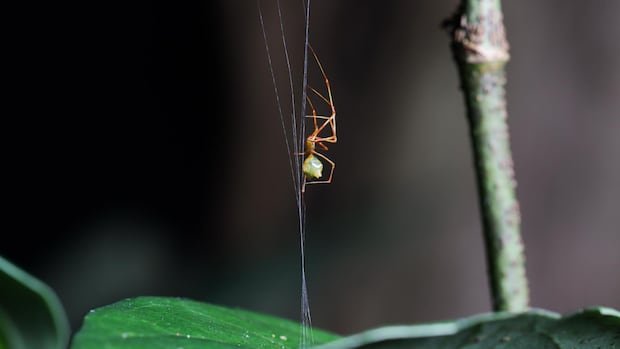
A new spider species found in the tropical rainforests of Australia has surprised scientists with its unique hunting method that propels prey into the air using a spring-loaded silk trap.
The spider, part of the Propostira genus and yet to be formally named, constructs a cone-shaped snare to launch green tree ants into its web, earning it the moniker “ballista spider” in reference to ancient Roman projectile weaponry.
Biologist Ajay Narendra from Macquarie University in Australia described witnessing the spider’s behavior as awe-inspiring. The discovery was initially made by researcher Greg Anderson in 2022 in a remote rainforest in Queensland, prompting a research team to investigate in 2023.
Using high-speed cameras, the team spent 10 days documenting the spiders’ hunting strategy. The spiders, which are nocturnal and measure three to five millimeters in length, hide under leaves during the day and construct intricate traps under their main webs at night.
By anchoring silk tension lines to lower points and forming a cone structure, the spiders lure green tree ants that become trapped and eventually launched into the air as the tension is released, leading them directly into the waiting predator’s web.
Researchers believe the silk may contain pheromones specifically attracting green tree ants. This hands-off approach allows the spiders to hunt formidable prey without direct confrontation.
The launch process occurs within milliseconds, subjecting the ants to significant G-forces. This hunting tactic distinguishes the ballista spider from the slingshot spider, another species with a similar mechanism but a more active hunting strategy.
The ballista spider’s ability to store energy in its silk trap for launching prey with force while maintaining a safe distance highlights its evolutionary adaptation for efficient hunting.
The ongoing study aims to uncover the role of pheromones in prey specialization. Saad Bhamla, an associate professor at the University of Colorado-Boulder’s BioFrontiers Institute, suggests a simpler explanation for the spiders’ prey targeting mechanism.
The continuous exploration of nature’s wonders underscores the ongoing discoveries awaiting in the scientific realm.

