
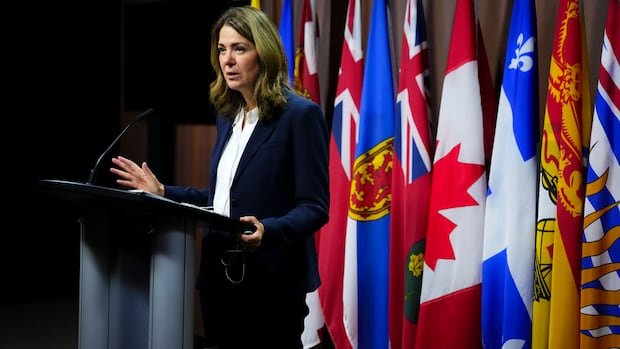
Alberta Premier Danielle Smith has expressed willingness to make adjustments to Alberta’s industrial carbon pricing program, including the industrial carbon price set by the province. Alberta recently announced a continuation of the freeze on the industrial carbon price at $95 per tonne until 2026, diverging from the federal government’s backstop price, which is scheduled to increase to $110 per tonne next year.
During a media briefing in Ottawa following a meeting with Prime Minister Mark Carney, Smith highlighted that Alberta believes its current carbon price strikes a balance between industry viability and promoting investments in green technology. She mentioned that the $95 per tonne carbon price is subject to discussions as part of ongoing program adjustments.
The Premier emphasized the importance of maintaining carbon pricing at the provincial level, citing Alberta’s experience with carbon pricing since 2007. Concerns have arisen regarding potential federal intervention through the backstop mechanism if Alberta’s industrial carbon pricing program fails to align with federal standards.
Alberta has proposed revisions to its industrial carbon pricing program, offering companies the opportunity to invest in emissions reduction projects to avoid provincial fees for emissions. Additionally, smaller companies that do not meet the program’s emissions threshold may opt out of the carbon pricing system for 2025. These changes are expected to take effect in the coming months.
Despite industry support for these modifications, experts caution that the adjustments could discourage investments in clean growth. The uncertainty surrounding Alberta’s cap-and-trade system has raised concerns about potential market impacts, with projected carbon prices possibly falling significantly.
Smith is engaged in discussions with Carney to facilitate the construction of a new pipeline connecting Alberta to the British Columbia coast. She has urged the federal government to lift the tanker ban off the B.C. coast, revoke the electric vehicle sales mandate, eliminate the oil and gas emissions cap, and abolish the federal industrial carbon price to grant provinces regulatory autonomy.
The Premier has proposed a “grand bargain” that would advance the Pathways Alliance carbon-capture project alongside an oil pipeline to Canada’s West Coast. Smith aims to submit the pipeline project for consideration by Ottawa’s Major Projects Office by next spring, with hopes of finalizing a deal by the time of the Grey Cup on November 16.
Federal ministers have refrained from confirming whether the federal backstop would be imposed on Alberta in case of non-compliance with federal regulations, raising uncertainties about potential enforcement actions. Carney’s focus on strengthening industrial carbon pricing as a trade-off for consumer carbon price repeal underscores the evolving dynamics of carbon pricing policies in Canada.
Carbon pricing systems like Canada’s industrial model establish emission caps to incentivize emissions reduction investments. The effectiveness of such systems relies on setting appropriate price levels to encourage emission reduction initiatives over credit purchases. Smith’s negotiations with Carney reflect ongoing efforts to navigate complex environmental and economic considerations in carbon pricing and infrastructure development.

