
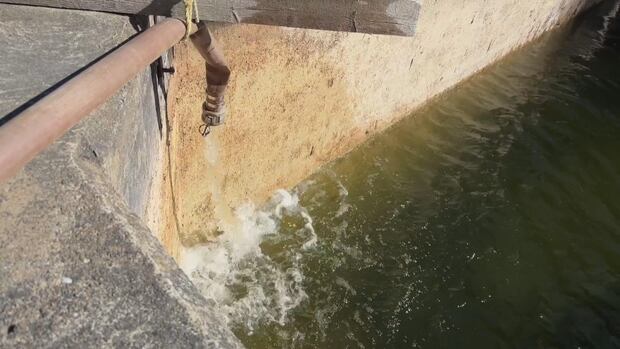
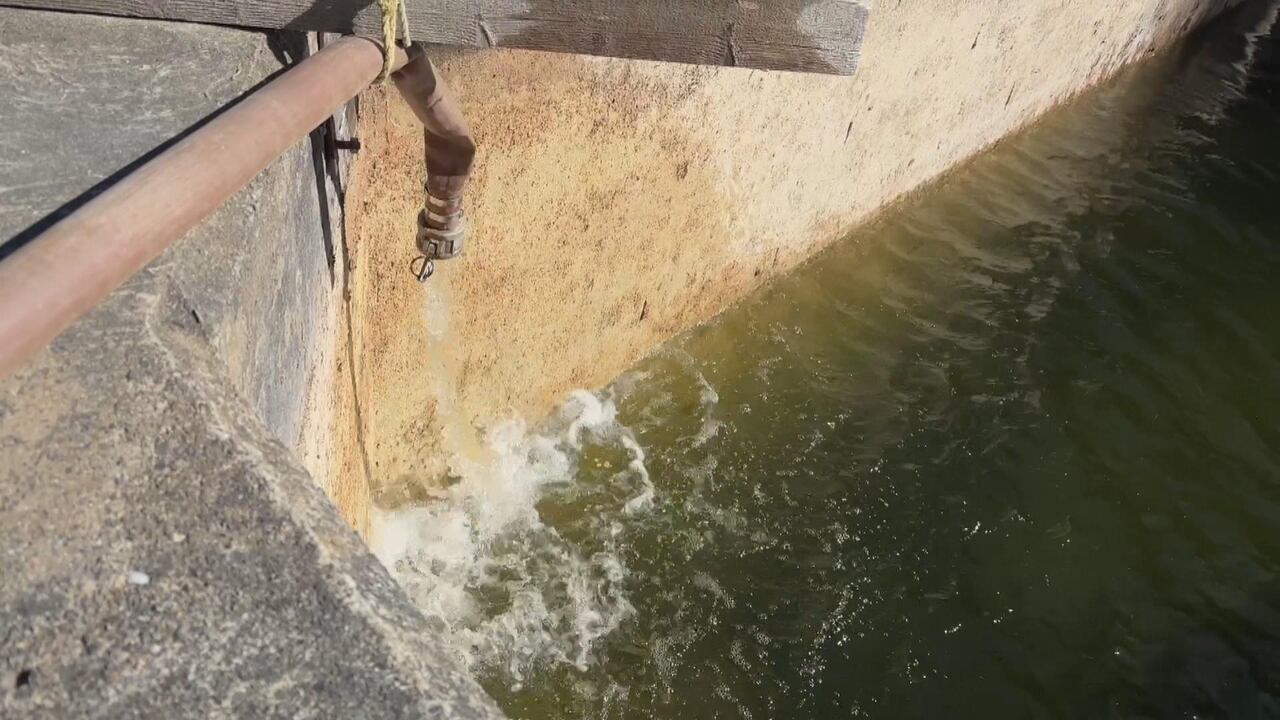
Water is currently being brought in to fill the Hughes Brook dam. (Amy Feehan/CBC)
A state of emergency is currently in effect for a community located on Newfoundland’s west coast due to critically low water levels, with water being transported from a nearby town to replenish the Hughes Brook dam.
Hughes Brook, which has a population of around 236 according to Statistics Canada, announced the state of emergency last week. In a social media update on Tuesday, the town confirmed that both the state of emergency and a water conservation directive are still in place.
Melissa Thorne, the town clerk, stated that the water supply is turned off until further notice as they are in the process of filling the dam, and the disturbed sediments will need time to settle.
Nonetheless, she indicated that importing water to fill the dam will not resolve the state of emergency.
“At this time, it will not lift the state of emergency. We are assessing the situation on a day-to-day basis since we are still facing challenges,” Thorne told CBC News.

Town clerk Melissa Thorne indicates that the community is exploring a new water source. (Amy Feehan/CBC)
Approximately 60 of the nearly 100 homes in the community are linked to the affected water supply.
The town’s announcement also cautioned residents that they are legally obligated to conserve water and restrict usage to essential purposes such as drinking, cooking, and hygiene. Additionally, it noted that failure to conserve water could lead to legal consequences under the Towns and Local Service Districts Act.
‘Epidemic across the province’
Thorne referred to the ongoing water shortages as an “epidemic across the province,” affecting not just Hughes Brook.
“In addition to the obvious lack of rainfall and reduced snowfall during winter, the extremely hot and dry summer has contributed to the situation. We are not the only town experiencing water shortages,” she stated.
Other towns throughout the province have encountered similar difficulties over the summer months.
In August, Bonavista implemented a mandatory water ban to conserve water for essential needs like drinking and sanitation. Last week, Torbay Mayor Craig Scott issued a warning about low water levels at the town’s reservoir, indicating that a state of emergency might be declared.

Hughes Brook declared a state of emergency last week due to critically low water levels. (Amy Feehan/CBC)
Thorne mentioned that they are investigating a potential leak at a town fire hydrant as a possible factor contributing to the low water levels in the dam.
“We conducted leak detection tests last night and the night before and identified a likely leak that will be addressed tomorrow,” she noted.
Thorne added that residents are visiting the town hall to request drinking water, and staff are available to provide assistance.
-
N.L. posted record heat warnings in August, which could likely increase, say climate scientists
-
Farmers say N.L. agriculture is in ‘crisis mode’ following hot, dry grow season
In light of the insufficient precipitation, reduced snowfall during winter, and the impacts of climate change, she emphasized the necessity for a new water source for the community.
The town has recently received approval for funding to search for a new water source, which will soon be put out for tender.
“This presents another opportunity for us to identify a water source that could effectively supply the town and support its growth, as we currently have only about 62 connections to the water supply,” Thorne explained.
Download our free CBC News app to sign up for push alerts for CBC Newfoundland and Labrador. Click here to visit our landing page.

