
A SpaceX rocket carrying two lunar landers crashed into the moon as expected on Wednesday after veering off course for the past year, scientists confirmed. While the high-speed collision at 8,700 km/h was not directly witnessed, a telescope in Chile captured the debris plume resulting from the impact, which space tracking experts anticipated the rocket segment would hit the moon.
This incident adds to the concern of increasing lunar debris, especially as the U.S. and China compete to land astronauts on the moon. In 2022, a Chinese rocket unintentionally struck the moon after a lunar mission, and numerous other stray rocket components may have impacted the moon unnoticed in previous decades.
Julianna Scheiman from SpaceX stated that the company is collaborating with NASA to prevent future accidents, emphasizing that this collision was not intentional but rather a result of solar activity and gravitational forces diverting the rocket towards the moon.
Boston University’s Carl Schmidt expressed absolute certainty that observations by his team confirmed the lunar crash, citing the European Southern Observatory’s Very Large Telescope detecting a stream of sodium and lithium extending into space for several minutes post-impact.
Despite the lack of visual evidence of the impact, retired astrophysicist Jonathan McDowell highlighted that the rocket’s trajectory was headed towards the moon, with the anticipated crash site near Einstein Crater on the moon’s sunlit western limb, a challenging area to observe from Earth.
Stargazers acknowledged the difficulty of witnessing the impact from the ground and expected that orbiting spacecraft might capture the aftermath. Visual confirmation awaits NASA’s Lunar Reconnaissance Orbiter to fly over the crash site and provide images of the impact crater, anticipated to occur next week.
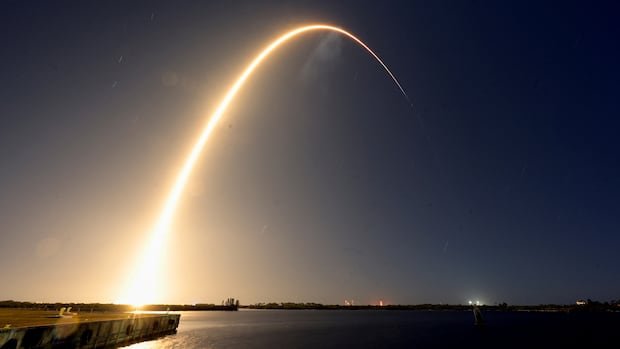
The Falcon rocket’s upper stage, carrying two private lunar landers, was launched from Cape Canaveral, Florida, on January 15, 2025. One of the landers, Firefly Aerospace’s Blue Ghost, successfully landed, while the other, ispace’s Resilience, met a different fate. The moon is increasingly becoming a focal point for space exploration, with plans for a sustainable lunar base and manned missions in the near future.
McDowell emphasized the necessity for responsible space activities near the moon as commercial and government entities ramp up missions in the lunar vicinity. The potential for increased space traffic raises concerns about the management of debris and impacts on celestial bodies.

