
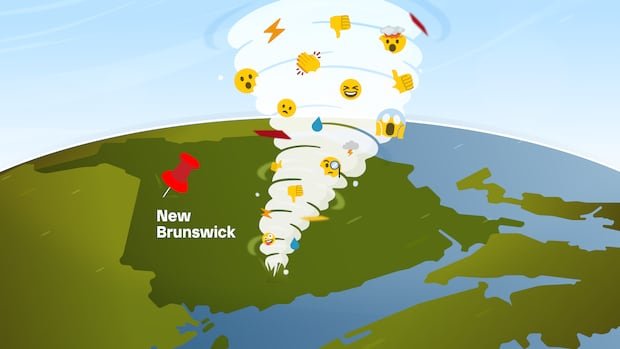
On July 14, Environment Canada issued a severe thunderstorm watch for New Brunswick, indicating favorable atmospheric conditions for thunderstorm development. The watch also mentioned a potential tornado risk. Despite no severe storms or tornadoes occurring, social media saw a surge in misinformation and panic.
Sander van der Linden, a psychology professor at the University of Cambridge, highlighted that extreme weather situations often attract misinformation due to the urgency and uncertainty involved. He explained that an Environment Canada “watch” is a precautionary measure for potential severe weather, while a “warning” indicates immediate action is necessary as severe weather is either happening or imminent.
Jill Maepea, an Environment Canada meteorologist, mentioned that the tornado risk was low when the severe thunderstorm watch was issued. She emphasized the challenges in predicting convective weather that can develop rapidly and dissipate quickly.
Following the watch, social media users criticized the delay in Environment Canada’s notice about the storm. Misinterpretations led to false claims of tornado warnings, adding to the confusion. Van der Linden pointed out that official communication can sometimes be misinterpreted if people lack understanding of the information provided.
After the storm watches ended, social media continued to stir controversy with some expressing disappointment at the lack of a storm and others sharing fake images of non-existent weather events. The rise of hyperrealistic AI technology has blurred the lines between real and fake content online, making it challenging for users to discern truth from misinformation.
Aaloak Jaswal, from the University of New Brunswick’s Data Science and AI Research Institute, emphasized the increasing ease of spreading misinformation with AI-generated content. He noted the importance of verifying sources and information before sharing during emergencies to prevent the spread of false information.
Overall, experts advise caution in consuming and sharing information during emergencies, advocating for proactive measures like “pre-bunking” to educate others on recognizing and avoiding misinformation. Building trust in official sources and fostering a community-led approach to ensure accurate information dissemination is crucial in maintaining public safety.

