
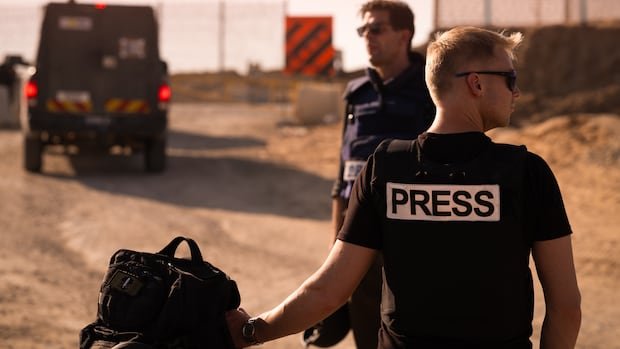
At the southern tip of Gaza’s border with Israel, we venture into a conflict zone. Dusty pathways traverse a desolate desert near the Egyptian border. Israeli soldiers stationed at the checkpoint appear disinterested. Given strict instructions from Israeli military officials, we refrain from taking photographs.
Our convoy of humvees, packed with cameras, transports a group of twelve journalists from various countries, all clad in bulletproof vests and helmets, to a parking area approximately 200 meters away. Despite numerous requests from CBC News and other media outlets for increased access, Israel’s military only permits escorted or “embedded” visits for a limited period.
Following international criticism from various organizations and governments, Israel aims to address concerns regarding the distribution of aid to deprived Palestinians in Gaza. On this particular day, Israeli aid distribution agency COGAT’s spokesperson, who remains anonymous, explains that delays in aid delivery are primarily due to bureaucratic hurdles imposed by Israel on imports and a lack of adequate security along the patrolled routes inside Gaza.
Bags of rice, corn, and cans of fish, labeled with organizations such as UNICEF, Red Cross, and World Food Program, are stacked under the scorching sun in the parking lot. While Israel emphasizes its efforts in allowing almost 300 aid truckloads daily, the United Nations attributes the aid delivery challenges to Israeli-imposed restrictions and security issues.
Access for independent journalists remains a significant challenge, with Israel citing safety concerns for journalists in Gaza and asserting the risks posed to its military operations. The inability of foreign reporters to enter Gaza independently has raised questions about the reported widespread starvation and death toll figures, with Israel refuting claims of a famine and dismissing casualty statistics provided by Gaza health officials as biased propaganda.
The limited presence of international journalists in Gaza has left Palestinians feeling neglected and unseen by the world. While some speculate a loss of global interest, others like Tehilla Shwartz Altshuler, a media policy expert at the Israel Democracy Institute, suggest that Israel’s restrictive media strategy has had unintended consequences, limiting transparency and potentially distorting the narrative.
Local journalists, serving as primary sources for major media outlets, including CBC News, have risked their lives to document the realities of the conflict in Gaza. Ghada Al-Kurd, a Palestinian journalist reporting for various international media, shares her firsthand experiences of the hardships faced by Gaza’s population, emphasizing the need for global awareness.
The escalating violence in Gaza has resulted in the deaths of numerous journalists, with the UN Human Rights Office reporting at least 247 fatalities since October 7, 2023. Journalists in Gaza face intimidation and threats, with accusations from Israel of colluding with Hamas, a tactic believed to silence critical voices.
Israeli media coverage of events in Gaza during the conflict has been selective, often downplaying civilian casualties and food shortages or echoing official government narratives. Public opinion in Israel, as reflected in a recent poll, indicates a preference for a limited perspective on Gaza’s humanitarian crisis.
The shift towards nationalist reporting in Israeli media postulates a narrative of patriotism and local pride over potentially uncomfortable truths. As global protests and diplomatic rebukes against Israel gain momentum, many within Israel remain bewildered by the international backlash, questioning its origins.

