
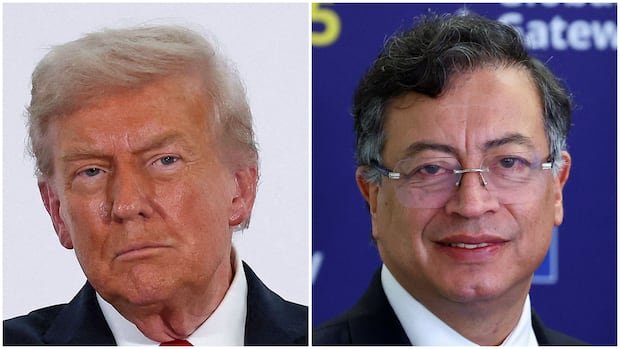
Colombia has taken the step of recalling its ambassador from the United States following President Donald Trump’s announcement of imposing higher tariffs on the country and halting all payments to it. The dispute arose from U.S. military actions on vessels suspected of carrying drugs.
President Trump’s labeling of Colombian President Gustavo Petro as an “illegal drug leader” has been deemed offensive by Petro’s administration. The Colombian foreign ministry confirmed that Ambassador Daniel Garcia-Pena has been summoned back to Bogota for consultations by President Gustavo Petro, with further decisions to be announced soon.
This exchange of remarks between the two leaders has strained relations between Washington and Bogota, with Trump accusing Colombia of involvement in the drug trade. Petro has criticized the U.S. military’s lethal strikes on vessels in the Caribbean, which the Trump administration claims were necessary to prevent an imminent threat posed by “narcoterrorists” linked to Venezuelan President Nicolás Maduro.
Numerous legal experts and human rights activists have condemned the military operations and raised concerns about their legality, as the U.S. has portrayed drug traffickers on boats as illegal combatants.
President Trump has also mentioned cutting off U.S. financial aid to Colombia and introducing new tariffs, although the specific funding targeted by Trump remains unclear. Formerly a major recipient of U.S. aid in the region, Colombia experienced a sudden reduction in assistance this year following the closure of USAID.
Colombia’s largest trading partner, the United States, currently imposes a 10% tariff on most Colombian goods. The South American nation heavily relies on exports to the U.S., particularly in oil, coal, coffee, flowers, and bananas. Statistics from the Colombian-American Chamber of Commerce show that shipments to the U.S. constitute 35% of Colombia’s total exports, with a trade deficit of $338 million recorded in the first seven months of the year.
In response to the recent events, President Petro has condemned the bombing of a vessel that resulted in casualties, disputing U.S. claims regarding the ownership of the boat. He has pledged significant intervention in coca-growing regions but has faced challenges in curbing drug production.
Over the years, the U.S. has provided substantial foreign aid to Colombia to combat illegal coca cultivation, enhance military capabilities against drug-related rebels, and offer economic alternatives to impoverished farmers involved in the drug trade. However, court rulings in Colombia have deemed U.S.-backed glyphosate spraying programs as potentially harmful to the environment and farmers.
The cultivation of coca, the primary ingredient in cocaine, has surged in Colombia, reaching a record 253,000 hectares in 2023. Despite the U.S. bolstering its military presence in the Caribbean, details about the recent boat strikes, including the quantities of drugs seized and casualties, remain limited.
Democratic lawmakers and Republican Sen. Rand Paul have demanded more transparency regarding the U.S. strikes, which have resulted in multiple fatalities. Survivors of the boat incidents have been repatriated to Colombia and Ecuador, with concerns raised about the legality of the attacks.

