
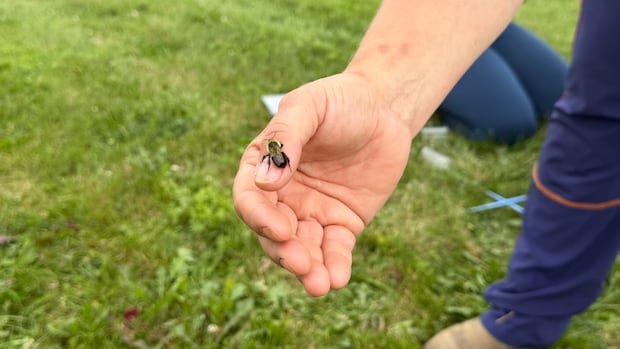
Equipped with tools like insect nets, vials, and a temperature-controlled cooler, Nature NB is currently conducting surveys in Fredericton this summer to study the native bumblebee population, an important but often overlooked species in the area. This initiative marks the conservation group’s inaugural field season dedicated to tracking bumblebee species in the capital.
Inspired by the Mi’kmaq-led Unama’ki Institute of Natural Resources in Cape Breton, the program aims to establish a comprehensive map detailing bumblebee locations and habitats not only in New Brunswick but also across the Maritimes. Francie Morgan, the program co-ordinator at Nature NB leading this effort, emphasized the need for consistent surveys to establish baseline data for future comparison and informed conservation decisions.
The primary focus of the project is to assist landowners and municipal partners in making well-informed choices to safeguard pollinators. Nature NB collaborates with various organizations, including the Amlamgog (Fort Folly) Habitat Recovery team, EOS Eco-Energy, and the Pays de Cocagne Sustainable Development Group, as part of a broader provincial mapping initiative.
Morgan and her team are currently surveying three sites in different neighborhoods on Fredericton’s north side, identifying bumblebee species based on distinct color patterns and shapes on the bee’s body. Despite being early in the season, the team has already documented six different bumblebee species in the initial June survey. New Brunswick is home to 18 bumblebee species, as per the province’s records.
The collected data is shared with partners like the Unama’ki Institute, the Atlantic Canada Conservation Data Centre, and iNaturalist, a global open-source database utilized by researchers worldwide. Morgan highlighted the significance of this information exchange in aiding research and conservation efforts, particularly for migratory species like monarchs and bumblebees.
Recognizing the interconnectedness of species, Morgan emphasized that protecting bumblebee habitats benefits not only bumblebees but also other vital pollinators like wasps, monarchs, and hummingbirds, ultimately contributing to a healthier ecosystem. Nature NB’s program is timely, coinciding with the release of a draft recovery strategy by the New Brunswick government for two locally threatened bumblebee species: the Bohemian cuckoo bumblebee and the yellow-banded bumblebee.
Shaylyn Wallace, the species at-risk manager at the Department of Natural Resources, highlighted the need for standardized monitoring protocols across the province to enhance conservation efforts. Better understanding bumblebee locations through data collection is crucial for effective conservation management, requiring support from researchers and non-profit organizations to address existing knowledge gaps.
Native bumblebees play a vital role in maintaining ecosystem stability and biodiversity, promoting resilience in the face of environmental challenges like climate change. To support wild pollinators, Morgan suggested that residents can start by allowing some yard space to grow wild, creating essential foraging habitats for bumblebees and other native species.

