
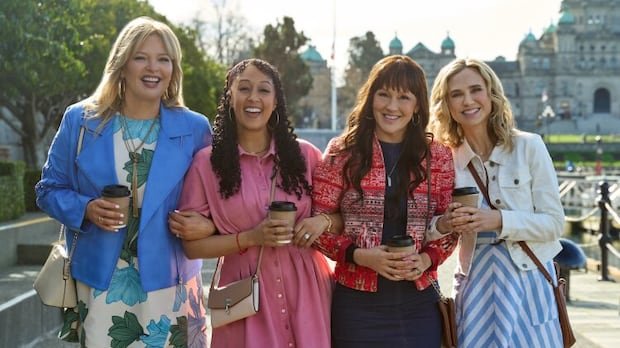
An upcoming film on the Hallmark Channel, titled “All’s Fair in Love and Mahjong,” has sparked criticism for what some perceive as a lack of sensitivity towards the Chinese cultural aspects central to its storyline. The movie, depicted as per the Hallmark Channel’s official description, revolves around a school nurse who discovers a newfound sense of hope through teaching and playing Mahjong, a Chinese tile-based game that dates back to the 1800s. Initially introduced in the United States in the 1920s, Mahjong gained popularity, particularly with Jewish players post-World War II, and is currently enjoying a resurgence, attracting a younger audience with modernized boards and stylish social settings.
The lead role in the Hallmark movie is played by Yan-Kay Crystal Lowe, a Canadian actress with a Chinese heritage who spent part of her childhood in Hong Kong. Her character is part of a Mahjong club alongside another woman, portrayed by Fiona Gubelmann, who aims to unite communities through their shared love for the game. However, despite Lowe’s representation, the absence of Asian actors in the remaining cast members has raised concerns regarding the lack of diversity in a film centered around Chinese culture.
Following the recent unveiling of a movie poster featuring Lowe, Gubelmann, Tamera Mowry-Housley, Paul Campbell, and Melissa Peterman, criticism surfaced online, with individuals expressing disappointment over the casting choices. Notable figures such as Nancy Wang Yuen, author of “Reel Inequality: Hollywood Actors and Racism,” and Philip Wang, co-founder of Wong Fu Productions, voiced their discontent, labeling the casting decisions as tone-deaf and disrespectful, especially given the timing close to Asian American and Pacific Islander Heritage Month.
Set to premiere on May 9, the film, directed by Canadian filmmaker Jessica Harmon, aims to explore themes of love, family, and friendship, with a focus on Mahjong as a cultural symbol that bridges generations and communities. While the movie’s full content and treatment of Chinese culture remain undisclosed, a Hallmark spokesperson assured that the heritage of Mahjong is acknowledged and respected within the narrative.
The debate surrounding Asian representation in the media is not new, with instances like “All’s Fair in Love and Mahjong” prompting discussions on the industry’s failure to adequately portray and include Asian stories and actors. The controversy surrounding the casting choices in productions like Broadway’s “Maybe Happy Ending” reflects a broader issue of whitewashing and the reluctance of studios to cast Asian leads, despite the success of recent projects with Asian talent.
Highlighting the significance of Mahjong and the current trend of engaging with Chinese culture, the lack of authentic Asian representation in films like “All’s Fair in Love and Mahjong” continues to draw criticism from advocates like Madelyn Chung, founder of the RepresentAsian Project. Chung emphasized that while the appreciation for Asian cultural elements is evident, the exclusion of Asian individuals from projects perpetuates a harmful narrative of selective cultural appropriation, disregarding the Asian community’s identity and contributions.

