
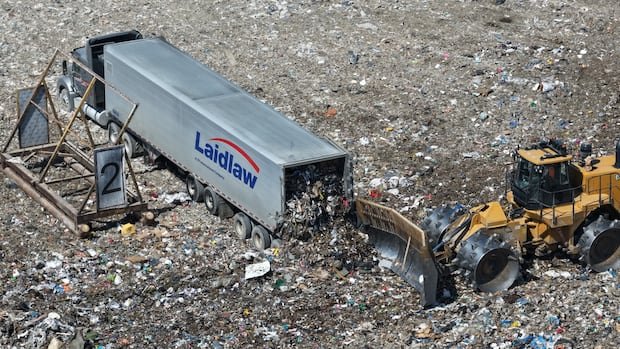
Toronto’s primary landfill is nearing capacity and is projected to reach its limit within a decade. City officials are evaluating various long-term strategies to handle the increasing waste output.
An upcoming report scheduled for presentation to the city’s infrastructure and environment committee in September discusses the advancements made in Toronto’s residual waste management plan, initially approved by the council in 2023. It highlights concerns that the Green Lane Landfill, located approximately 40 minutes southwest of London, Ontario, may reach full capacity by 2034 or 2035 due to population growth and new housing developments contributing to the waste stream.
Several options are being considered by the city, including expanding Green Lane through vertical and horizontal extensions that could potentially prolong its lifespan until 2060. Additionally, discussions have been initiated with other municipalities and private landfill operators in Ontario to explore the possibility of establishing a new landfill, although no concrete interest has been expressed thus far. The feasibility of implementing a waste-to-energy facility, where garbage would be incinerated to generate heat for steam and electricity production, is also under review, a technology already operational in Durham Region.
However, environmental organizations and nearby Indigenous communities have raised objections, claiming that the consultation process has been misleading and overlooks the communities most impacted. Emily Alfred from the Toronto Environmental Alliance emphasized the importance of enhancing waste diversion efforts rather than pursuing energy-from-waste solutions, citing the significant greenhouse gas emissions associated with incineration.
Located near three First Nations communities, including Chippewas of the Thames, Munsee Delaware, and Oneida Nation of the Thames, Green Lane’s operations have sparked concerns about pollution and environmental effects among residents. Rosalind Antone from Oneida Nation highlighted the lack of consultation with the affected communities and emphasized the need for collaboration to address the issues.
Responding to the mounting pressure as landfill space diminishes across Ontario, Atif Durrani, the project director for business transformation residual waste at the City of Toronto, acknowledged the challenge of establishing new landfills due to regulatory requirements. Sara Little, the manager at Green Lane, mentioned the ongoing waste management efforts and the utilization of methane gas for electricity generation at the site, which can power thousands of homes. Little assured that the City of Toronto would oversee the landfill post-closure for an extended period.
Moving forward, the report outlines forthcoming actions, such as conducting technical assessments on landfill expansion and waste-to-energy initiatives. City officials plan to deliver recommendations for a sustainable long-term solution by 2027 while emphasizing the importance of waste diversion through recycling, organics, yard waste programs, and reduction strategies. The primary goal remains reducing waste generation as a fundamental priority in waste management practices.

