
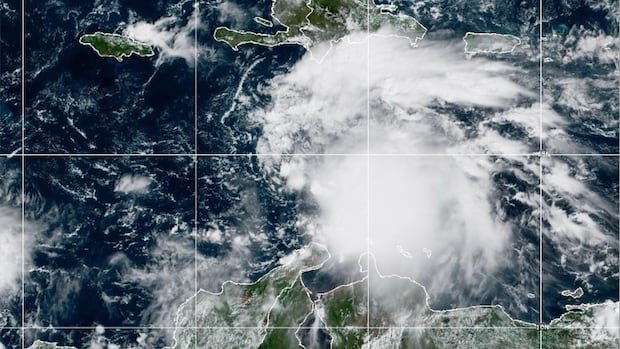
Tropical Storm Melissa made its way across the Caribbean Sea, posing a threat of hazardous landslides and potentially life-threatening flooding to Jamaica and the southern part of Hispaniola, shared between the Dominican Republic and Haiti.
The storm caused a fatal incident in Marigot, southern Haiti, where an elderly man lost his life after a large tree fell on him. Additionally, five individuals sustained injuries due to flooding in the central Artibonite region as reported by the Civil Protection Agency. Authorities advised residents in flood-prone areas to move to higher ground.
Located approximately 345 kilometers southeast of Kingston, Jamaica, and about 440 kilometers southwest of Port-au-Prince, Haiti, the slow-moving storm boasted maximum sustained winds of 80 km/h, with a northwest trajectory at 7 km/h, according to the U.S. National Hurricane Center in Miami. A hurricane watch was issued for Jamaica and the southwestern peninsula of Haiti, while a tropical storm warning was in place for Jamaica.
Forecasts indicated that Melissa would linger over open waters but draw closer to Jamaica and southwestern Haiti later in the week, potentially intensifying significantly by the weekend. AccuWeather’s lead hurricane expert, Alex DaSilva, warned that the warm waters and sluggish movement of the storm could lead to rapid intensification, possibly escalating into a Category 5 hurricane.
Preparations were underway in Jamaica, with Barbara Campbell from Kingston sharing her concerns and readiness for the impending storm. Authorities announced the availability of 881 shelters as a precautionary measure, with courts closed, schools transitioning to remote classes, and the placement of 1,000 sandbags in eastern Kingston to prevent flooding.
Evan Thompson, director of Jamaica’s Met Service, highlighted the potential for up to 30 centimeters of rainfall in the island’s eastern region, emphasizing the significance of this precipitation. In the Dominican Republic, numerous individuals sought refuge in shelters, and essential services were suspended in response to the storm alert issued in nine provinces.
Haiti, known for its vulnerability to natural disasters, raised alarms due to the storm’s expected impact, compounded by existing challenges such as erosion, gang violence, poverty, and governance issues hindering adequate preparations. The UN Office for the Co-ordination of Humanitarian Affairs allocated $4 million US to assist over 10,000 vulnerable individuals in Haiti with evacuation support, cash transfers, emergency shelter management, and essential supplies.
Melissa marked the 13th named storm of the Atlantic hurricane season and the first to originate in the Caribbean this year. The U.S. National Oceanic and Atmospheric Administration had projected an above-normal season with 13 to 18 named storms, anticipating five to nine hurricanes, including two to five major hurricanes with winds exceeding 178 km/h. The Atlantic hurricane season spans from June 1 to Nov. 30.

