
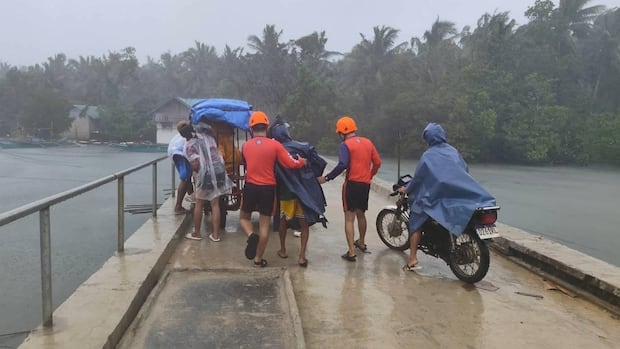
Super Typhoon Fung-wong made landfall on the northeastern coast of the Philippines on Sunday, resulting in at least two fatalities and prompting the evacuation of over a million residents from areas susceptible to flooding and landslides, according to officials.
The powerful storm struck the town of Dinalungan in Aurora province on Sunday night, following a day of intense rain and wind across northeastern provinces, with sustained winds reaching 185 km/h and gusts surpassing 230 km/h.
This typhoon is the most significant threat to the Philippines this year, affecting nearly two-thirds of the Southeast Asian archipelago with its extensive 1,600-kilometre-wide band of rain and wind.
Earlier on Sunday, Fung-wong approached from the Pacific while the Philippines was still grappling with the aftermath of Typhoon Kalmaegi, which resulted in at least 224 deaths in central island provinces on Tuesday before striking Vietnam, where it claimed at least five more lives.
President Ferdinand Marcos Jr. has announced a state of emergency in response to the widespread destruction caused by Kalmaegi and the anticipated impact of Fung-wong, known as Uwan in the Philippines.
Before noon on Sunday, government meteorologists detected Fung-wong over coastal waters near Pandan in eastern Catanduanes province, where heavy rain and fog have reduced visibility.
In the Philippines, tropical cyclones with sustained winds of 185 km/h or greater are classified as super typhoons, a term adopted years ago to highlight the urgency associated with severe weather events.
More than 916,860 individuals were evacuated from high-risk communities in northeastern provinces, including the Bicol region, which is particularly vulnerable to Pacific storms and mudflows from Mayon, one of the nation’s most active volcanoes.
Defence Secretary Gilberto Teodoro Jr., responsible for managing disaster response agencies and the military, cautioned about the potential catastrophic effects of Fung-wong during televised statements on Saturday.
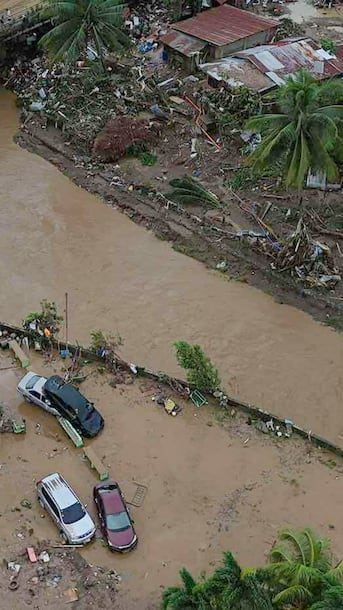
Eyewitness video from the Philippines shows vehicles being swept away by floodwaters unleashed by Typhoon Kalmaegi. The powerful storm unleashed heavy rains and floods across the central Philippines, submerging homes and leaving at least four people dead.
He noted that the storm could impact a large portion of the country, including Cebu, the central province hardest hit by Typhoon Kalmaegi, as well as metropolitan Manila, the densely populated capital and financial hub of the nation.
According to the Office of Civil Defence, over 30 million people may be at risk from Fung-wong.
Teodoro urged residents to heed official directives to evacuate from villages and towns at risk of flash floods, landslides, and coastal surges. “We need to act now because once it starts raining or the typhoon hits and flooding begins, rescuing people becomes extremely challenging,” he stated.
Despite the devastation caused by Kalmaegi, the Philippines has not requested international assistance, though Teodoro mentioned that both the United States, a longtime ally, and Japan are prepared to provide support.
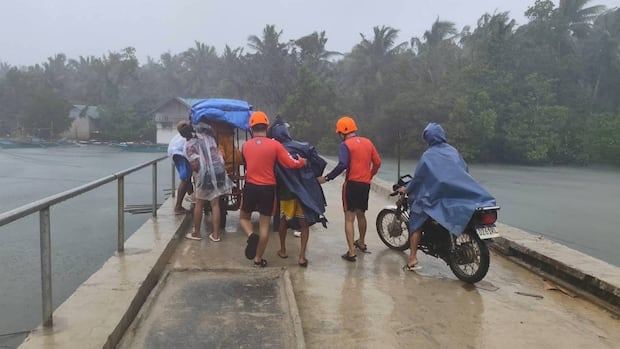
More than a million people have been forced to evacuate at-risk regions in the Philippines as Super Typhoon Fung-Wong batters the country’s northeastern coast ahead of landfall. Reiza Dejito, the country director for CARE Philippines, says the situation is dire and many of the same municipalities impacted this year were devastated by a super typhoon in 2024.
Local Red Cross chapters have established over 500 evacuation centers, providing shelter for nearly 21,000 families, as reported by Richard Gordon, chair of Red Cross Philippines.
“We’ve been extremely active and managing the situation,” Gordon shared with CBC News Network on Sunday shortly before Fung-wong made landfall. He noted that Red Cross Philippines has responded to eight or nine disasters this year, including Kalmaegi and a recent earthquake in Cebu in late September.
The organization has the necessary equipment and vehicles to clear debris and assist in rescuing individuals trapped in collapsed structures. Additionally, they have deployed food trucks to deliver hot meals in vulnerable mountainous regions.
Gordon reported that two individuals have already lost their lives as the storm approached, including one from a landslide, and he anticipated that the death toll would rise as the storm intensified.
“We have until Tuesday until the typhoon weakens, but our challenges lie in ensuring we can support those in evacuation centers and rescue those whose homes may collapse,” he stated.
As Fung-wong approached with its expansive band of strong winds and rain, numerous eastern towns and villages experienced power outages, according to Bernardo Rafaelito Alejandro, deputy administrator of the Office of Civil Defence.
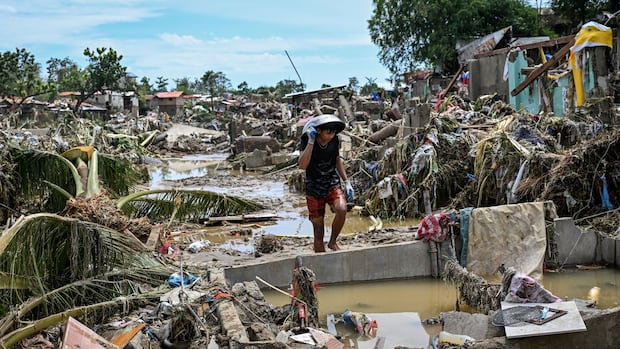
Residents of Talisay in the Cebu province of the Philippines are taking stock of their destroyed homes after Typhoon Kalmaegi barrelled into the country, setting off flash floods and killing over 100 people. ‘We were not able to save anything. The flood took even our rice. Everything,’ one resident said.
Officials in northern provinces expected to be impacted or grazed by Fung-wong have proactively announced the closure of schools and most government offices for Monday and Tuesday.
Reiza Dejito, country director for CARE Philippines, an emergency relief organization, reported that some regions experienced flash floods earlier on Sunday, cutting off several towns from electricity and mobile service, and blocking roads with debris.
“The situation is extremely serious,” Dejito stated, also appearing on CBC News Network. She pointed out that many of the same communities had been hit by typhoons the previous year. “For these families, it feels as though the recovery never truly started.”
At least 325 domestic flights and 61 international flights were cancelled over the weekend and into Monday, leaving more than 6,600 passengers and cargo workers stranded at 109 seaports, where the coast guard has restricted ships from entering the turbulent seas.
Authorities cautioned about a “high risk of life-threatening and damaging storm surge” exceeding three meters along the coasts of more than 20 provinces and regions, including metropolitan Manila.
The Philippines typically faces around 20 typhoons and storms annually. The nation is also frequently affected by earthquakes and hosts over a dozen active volcanoes, making it one of the most disaster-prone nations globally.

