
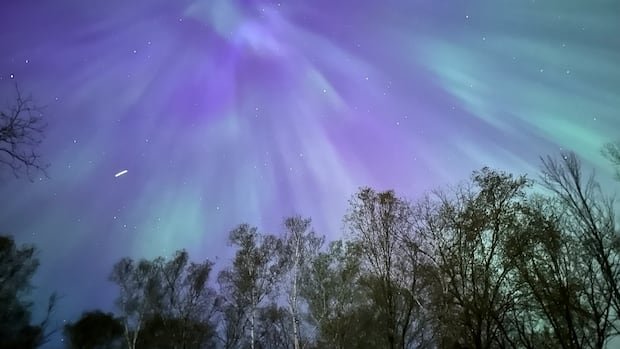
Southern Canadians have enjoyed occasional displays of vibrant neon-colored night skies in the past two years due to increased solar activity. However, as the sun enters a calmer phase of its 11-year cycle, the spectacle of the northern lights will diminish.
The prime locations to witness the auroras will continue to be in the Northwest Territories, Yukon, and Nunavut, where the auroral oval, a luminous ring encircling the magnetic poles, is most prominent. Ethen Sun, a Ph.D. candidate at the University of Toronto, noted that sightings of auroras in southern Canada, including regions in Ontario, British Columbia, Saskatchewan, and Manitoba, will become less frequent as solar activity decreases.
The sun undergoes periods of high activity known as solar maximum and low activity known as solar minimum. Currently, the sun is transitioning from the peak of solar maximum towards the upcoming minimum expected around 2031. Despite still being relatively active, the sun’s activity is gradually declining.
During the solar maximum phase, characterized by coronal mass ejections, flares, and geomagnetic storms, the northern lights exhibit vivid displays. Near the 60th parallel, auroras can be observed nearly every night regardless of solar activity levels. The best times to witness the auroras are between September and April, with particularly bright shows around the spring and autumn equinoxes.
As the sun’s activity diminishes, the intensity of the auroras seen over the past couple of years may fade. The timeframe for optimal viewing will also decrease as the solar activity subsides. Extra colors and movement in the auroras are typically associated with solar storms.
Tourism in the Yukon has strategically leveraged the solar maximum period between 2023 and 2025 to attract visitors, with the northern lights being a significant draw for tourists from the United Kingdom, Germany, Switzerland, and Australia. The territory generated $484 million in tourism revenue in 2025.
While the Northwest Territories and Yukon heavily promote their aurora experiences, Nunavut focuses more on showcasing Inuit culture, landscapes, and wildlife to tourists. However, as the solar maximum phase wanes, Nunavut may consider marketing itself as a prime location for northern lights viewing.
In the Northwest Territories, the auroras are a regular nighttime spectacle, with Yellowknife boasting up to 240 nights of northern lights annually. Approximately 41% of tourists visit N.W.T. specifically to witness the auroras. The northern lights play a crucial role in driving revenue for the territories, supporting various local businesses.
Aurora Village in Yellowknife actively tracks the solar cycle and provides insights on the optimal viewing opportunities in the Northwest Territories. Despite the fluctuations in solar activity, the unpredictability of the auroras continues to exceed expectations for visitors and remains a significant attraction for tourists.

