
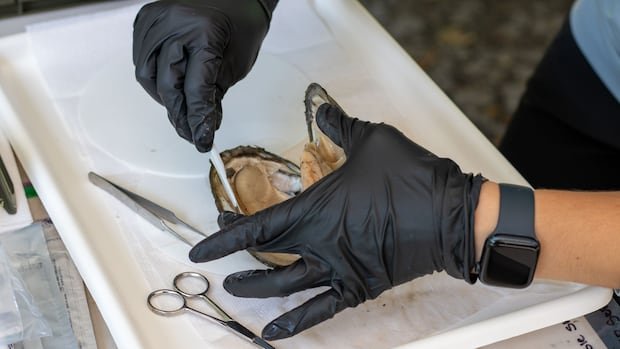
A group of scientists is conducting research on mussels in the Grand River in Brantford, Ontario, aiming to gain insights into the impact of certain chemicals on the environment. Patty Gillis, a research scientist at Environment and Climate Change Canada, leads a team based at the Canada Centre for Inland Waters in Burlington, Ontario. They utilize native freshwater mussels as indicators of water quality, investigating the presence and effects of contaminants.
Mussels, known for their stationary nature, dwell in sediment and filter water through their gills, making them susceptible to pollutants from both water and riverbed. Gillis explained that by analyzing a piece of mussel tissue, they can quantify exposure to substances like metals or pharmaceuticals, which may affect the mussels’ health.
The team is conducting sampling downstream of the municipal wastewater treatment plant to comprehend how individual chemicals and chemical mixtures impact diverse mussel species. This effort is part of the Integrated Chemical Mixtures Project (ICMP), a pilot initiative studying sites in Brantford and Windsor, Ontario. Other teams are investigating various species such as snails, birds, and fish to broaden the project’s scope.
Mark Hewitt, a Burlington chemist involved in the ICMP project, emphasizes the importance of understanding complex chemical mixtures and their potential effects on the environment. The project aims to uncover unknown aspects of these mixtures, paving the way for identifying and addressing harmful impacts.
Gillis’s team is employing a multi-faceted approach, assessing the stress levels of mussels, analyzing their bodies for metals and chemicals, and studying the broader river environment. By comparing findings with other ICMP teams, the researchers can evaluate the extent of chemical concentrations in mussels’ tissue. The project aligns with the federal government’s recognition of the right to a healthy environment, emphasizing a collaborative approach to comprehensively understand environmental and health impacts.
In their fieldwork near the river, the team meticulously collects samples from mussels, measures stress indicators, dissects specimens, and analyzes soft tissue for accumulated contaminants. Gillis plans to expand the study by monitoring mussels upstream and downstream of the wastewater plant and an industrial zone, alongside experiments on fish, shrimp, and snails to gauge responses to chemicals across different organisms.
The team’s ultimate goal is to gather information comprehensively, identify effects, and investigate causal factors, with the intention to extend the research to other regions in Canada in the future.

