
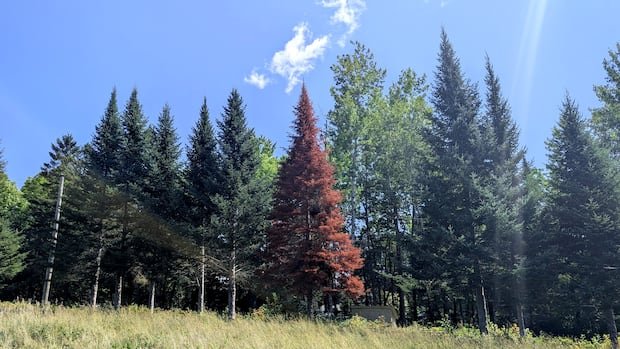
Balsam fir trees in New Brunswick are exhibiting a concerning phenomenon of turning red and perishing following the unprecedented drought experienced last summer, raising worries about the fate of this iconic provincial tree. Professor Anthony Taylor, a forestry researcher at the University of New Brunswick, has been closely monitoring reports from woodlot owners and witnessing the visible damage firsthand. The once-vibrant evergreen trees, often sought after as Christmas trees, are gradually transitioning to a red, desiccated state before succumbing to death.
Prof. Taylor, with his extensive expertise in studying the impact of climate change on New Brunswick’s forests, notes a recurring pattern of balsam fir decline in the aftermath of exceptionally hot and dry summers, such as those in 1986 and 2018. The adverse effects of warm, arid conditions, as witnessed during the previous year’s drought, hinder the growth capacity of balsam fir trees, leading to their impaired ability to photosynthesize and generate vital energy reserves essential for sustaining basic metabolic functions and defense mechanisms.
The shallow root system of balsam firs poses an additional challenge during dry spells, impeding their access to essential water sources. Peter McKeil, a woodlot owner in Burtt’s Corner, observed the distressing deterioration of balsam firs on his property since June, noting a progressive reddening of the lower branches upwards. The ongoing die-off, with new red spots appearing daily, has already claimed approximately 100 trees on his land. Despite salvaging some of the deceased trees for lumber, McKeil is adapting his harvesting practices to maximize the remaining fir’s value before further losses occur.
Expressing concerns about the future viability of the species in the face of escalating climate change impacts, McKeil foresees a grim fate for balsam firs in southern New Brunswick. He anticipates the imperative for adaptive measures or the gradual disappearance of the species, driven by the changing climatic conditions. The urgency for climate action is underscored by Taylor, who views the visual manifestation of red trees as a poignant indicator of the detrimental influence of a shifting climate on New Brunswick’s emblematic balsam fir.
Taylor emphasizes the urgent need for societal action to address climate change, advocating for a swift transition away from fossil fuel reliance and sustainable forest management practices. He asserts that the visible repercussions on balsam firs serve as a tangible reminder of the pressing need to accelerate climate mitigation efforts to avert further ecological disruptions caused by the changing climate landscape.

