
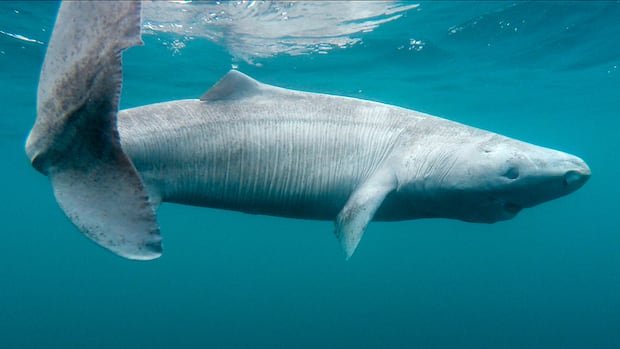
The discovery of a rare Greenland shark washed up on the coast of northwestern Ireland has stirred excitement among scientists. Emma Murphy, a zoology curator at the National Museum of Ireland, expressed astonishment at the find, as these elusive creatures typically inhabit the remote Arctic and North Atlantic oceans.
The species, considered exceptionally rare in Irish waters, had never been recorded stranded on Ireland’s coast before. Despite its uncommon appearance in Irish territory, one researcher suggests that the Greenland shark may have a broader habitat range than previously thought.
Initially mistaken for a basking shark by onlookers near Sligo, the Greenland shark’s identification sparked interest among scientists. Measuring up to seven meters in length, it is one of the largest carnivorous shark species globally and holds the record as the world’s longest-lived vertebrate, with a lifespan exceeding 270 years.
While primarily dwelling in cold Arctic and North Atlantic waters, these sharks have been spotted in various locations, including Belize and the Gulf of Mexico. Dean Grubbs, a shark scientist, emphasizes that their mobility and preference for cold temperatures allow them to explore various regions, indicating a more extensive distribution than commonly assumed.
Due to their deep-sea habitat, Greenland sharks are seldom encountered by divers. When Murphy and her team arrived at the scene to inspect the shark, they were thrilled by the opportunity to observe the majestic creature up close. The shark, a three-meter-long male nearing sexual maturity, appeared healthy with no apparent cause of death.
Although the exact origin of the shark remains unknown, researchers plan to preserve its skin and skull for public display at the National Museum of Ireland. This unique specimen will be showcased for future generations to appreciate and admire.

