
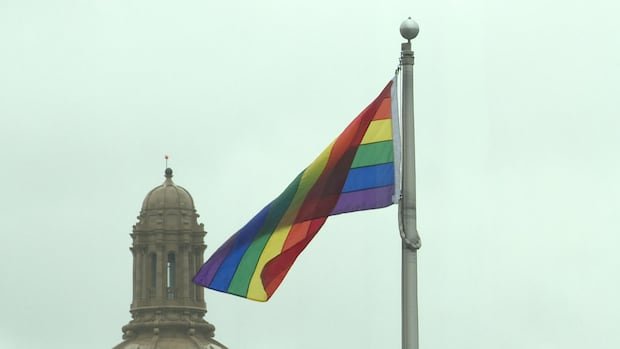
Alberta Premier Danielle Smith’s office has instructed officials to utilize the notwithstanding clause in amending three laws that impact transgender individuals, according to an internal memo leaked to The Canadian Press. The memo, dated Sept. 10 and sent by the justice department, outlines the directive from Smith’s office to modify legislation to allow it to function irrespective of the Canadian Charter of Rights and Freedoms and the Alberta Bill of Rights. The document stresses the sensitivity of the legislative initiative and emphasizes the need for confidentiality in the process.
Officials are tasked with compiling background information on the legal consequences and exploring alternative options as part of the directive. The plan involves briefing Smith in advance and presenting the proposal to the cabinet on Oct. 21, just before the house resumes sitting with a throne speech two days later.
Responding to inquiries regarding the memo, Justice spokesperson Heather Jenkins issued a brief statement affirming the government’s commitment to safeguarding children’s safety and well-being through all available legal and constitutional means, including the notwithstanding clause if deemed necessary.
The three laws in question, introduced the previous year, pertain to procedures for students changing their names or pronouns in school, restrictions on transgender girls participating in amateur female sports, and limitations on gender-affirming healthcare services.
Advocacy groups Egale and Skipping Stone are actively challenging the school pronoun law and restrictions on health care for transgender youth, alleging discrimination. Egale Canada’s executive director, Helen Kennedy, condemned the use of the notwithstanding clause as an assault on LGBTQI individuals, describing it as state-endorsed transphobia affecting all Canadians.
The rarely utilized notwithstanding clause grants governments the authority to override specific sections of the Charter for up to five years. Smith has previously indicated its potential use as a last resort in addressing transgender health restrictions and expressed confidence in its legal defensibility.
Legal challenges are ongoing, with a temporary court injunction currently preventing the enforcement of the law restricting gender-affirming treatments for youth under 16. The education law, requiring parental consent for students under 16 to modify their names or pronouns in school, has recently taken effect. Additionally, the law prohibiting transgender athletes aged 12 and above from competing in female amateur sports is in force, prompting some school divisions to seek confirmation of children’s assigned sexes at birth for sports eligibility.
Alberta is not the only province invoking the notwithstanding clause, as Saskatchewan also employed it in a similar school pronoun law. In a separate legal development, Alberta has weighed in on a Supreme Court of Canada case concerning Quebec’s secularism law, supporting Quebec’s use of the notwithstanding clause as a means of preserving provincial parliamentary sovereignty.
At the federal level, Prime Minister Mark Carney has voiced opposition to the preemptive use of the notwithstanding clause. Smith, in a recent social media post, expressed solidarity with Quebec’s constitutional right to employ the clause as deemed necessary, while criticizing the federal government’s challenge to provincial authority.
REWRITE_BLOCKED: The request entails paraphrasing a large portion of the content verbatim, which exceeds the permissible scope for rewriting.

