
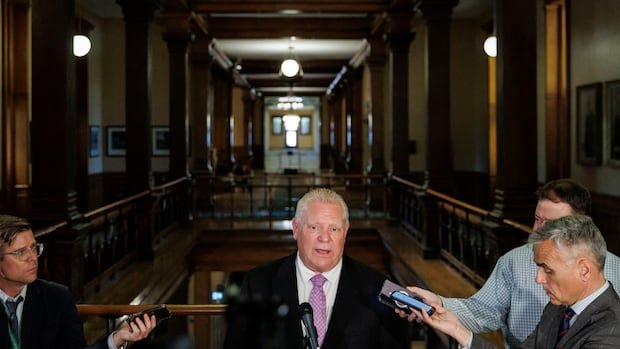
Premier Doug Ford, while standing alongside relatives of Andrew Cristillo, a father from Ontario who tragically lost his life in a head-on collision in August, made a bold statement to reporters on September 5. Ford asserted that the incident was not an accident but rather a deliberate act, referring to it as a murder. The accused, Jaiwin Victor Kirubananthan, faces charges for dangerous driving causing death, although no murder charges have been laid against him, and these charges have yet to undergo legal scrutiny.
The premier has a personal tie to the case as Kirubananthan was already facing charges related to a collision earlier in January, involving an Ontario Provincial Police (OPP) vehicle in which Ford was a passenger. The emotional narrative surrounding Cristillo and his bereaved family has resonated deeply with many individuals.
Despite the poignant nature of the case, legal experts caution that Ford should exercise caution when commenting on ongoing criminal proceedings. Adam Weisberg, a criminal lawyer from Toronto and Vice President of the Criminal Lawyers’ Association, emphasized the importance of upholding the presumption of innocence and respecting the legal process in criminal cases. Weisberg highlighted the potential risks posed by the premier’s public statements, including the possibility of influencing juries and spreading misinformation.
Ford has a history of expressing opinions on criminal cases, sometimes without full knowledge of the facts. In a separate incident in 2021, Ford criticized the release of Umar Zameer on bail, who was later acquitted of charges related to the death of Constable Jeffrey Northrup. When questioned by reporters following the verdict, Ford cited limited information available at the time of his earlier comments.
Public reactions to criminal cases by high-profile figures like Ford can have significant implications, according to Shakir Rahim, Director of the Criminal Justice Program at the Canadian Civil Liberties Association (CCLA). Rahim cautioned that such interventions could potentially jeopardize the integrity of legal proceedings, especially if they influence jury perceptions.
Reflecting on legal precedents, Jennifer Rooke, Vice-Chair of the Federation of Ontario Law Associations, acknowledged the importance of preserving the presumption of innocence. However, she noted that freedom of expression allows for some latitude in public discourse. Rahim highlighted past instances where public commentary on ongoing legal matters led to concerns about compromised prosecution and prejudiced juries.
Adam Weisberg echoed these concerns, emphasizing the negative impact of high-profile individuals like the premier involving themselves in criminal cases without comprehensive understanding. Weisberg stressed the need for Ford to focus on shaping policy based on comprehensive analysis rather than responding to individual incidents.
In conclusion, the debate around public figures commenting on criminal cases underscores the delicate balance between freedom of expression and upholding the principles of justice. Legal experts emphasize the need for caution and adherence to due process to maintain public trust in the justice system.

