
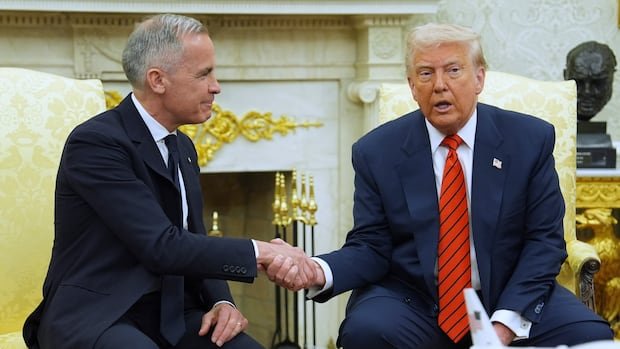
Prime Minister Carney is scheduled to visit the White House on Tuesday for a face-to-face meeting with U.S. President Donald Trump amid discussions on potential tariffs affecting Canadian industries. Carney’s office confirmed his travel to Washington on Monday evening in preparation for the talks.
The focus of the Prime Minister’s visit will revolve around mutual interests in establishing a new economic and security partnership between Canada and the U.S., according to a statement from Carney’s office. This meeting follows the initiation of public consultations by both countries last month in anticipation of the initial joint review of the Canada-U.S.-Mexico Agreement (CUSMA).
Negotiations between Canada and the U.S. have extended beyond the agreed trade deal deadline, with Carney complying with Trump’s request to revoke a tax on major U.S. technology companies and withdraw retaliatory tariffs in an effort to progress discussions, although a formal agreement has yet to materialize.
Canada’s Trade Minister, Dominic LeBlanc, expressed optimism that a deal could be reached before the CUSMA review next year, emphasizing the ongoing nature of the trade talks and the absence of a definitive impasse.
Trump has persistently pursued an aggressive tariff strategy against several countries, with recent actions including the imposition of new tariffs on softwood lumber and related products entering the U.S., intensifying challenges faced by Canadian producers amidst existing countervailing and anti-dumping duties.
As pressure mounts for a successful resolution, opposition voices, such as Conservative Leader Pierre Poilievre, have criticized the delay in achieving a tangible outcome from the negotiations, questioning the effectiveness of Carney’s approach in securing a favorable agreement with the United States.
Carney, who initially advocated for a comprehensive trade and security deal with the U.S., has shifted towards pursuing smaller agreements aimed at alleviating the impact of tariffs on various sectors such as metals, automotive, and lumber.
Despite examples of other countries securing tariff agreements with the U.S., Canada remains steadfast in rejecting any deal involving a baseline tariff, as emphasized by LeBlanc. Carney asserts that the majority of Canadian exports to the U.S. are currently tariff-free but stresses the necessity of relief for industries grappling with the repercussions of Trump’s tariffs, particularly in the metals, lumber, and automotive sectors.
Industries like aluminum and steel have been significantly affected by the tariffs, prompting the federal government to offer financial support to companies like Algoma Steel to aid in their operational sustainability and transition away from dependency on the U.S.
Carney maintains regular communication with Trump, including through text messages, and views the upcoming White House meeting as a pivotal opportunity to advance discussions in person. This visit marks Carney’s second trip to the White House since assuming office as Prime Minister.

