
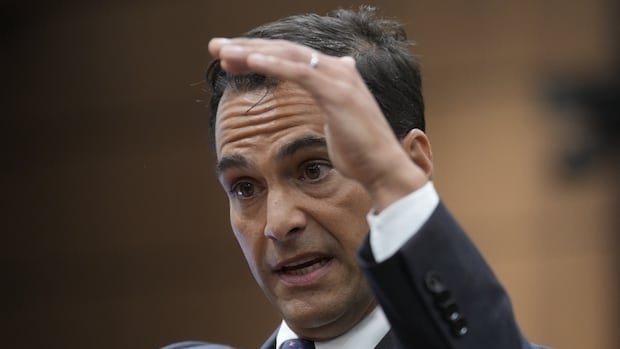
The parliamentary budget officer announced on Thursday an expected significant rise in Ottawa’s deficit in the upcoming fall budget, jeopardizing the government’s previous fiscal targets. According to the fiscal watchdog Jason Jacques, the federal deficit is projected to reach $68.5 billion this year, up from $51.7 billion last year. Jacques highlighted in a recent report that the federal debt-to-GDP ratio is no longer following a downward trend over the medium term, which was a crucial fiscal benchmark for the government.
The office’s updated fiscal and economic outlooks, released on Thursday, provide parliamentarians with a foundational estimate of the federal financial status leading up to the Liberals’ fall budget on November 4. Notably, the report does not incorporate plans to gradually increase defense spending to meet the new NATO benchmark of five percent of GDP by 2035, nor does it consider Ottawa’s proposed reductions in public service spending over the next three years.
Despite these factors, the report does include approximately $115.1 billion in net new expenditures over five years announced by the government since the last fiscal update in December. The weakened economy due to Canada’s trade tensions with the United States has led to decreased tax revenues for Ottawa, pushing deficits higher as the government increases capital expenditure.
The PBO forecasts a real GDP growth of 1.2 percent in 2025 and 1.3 percent in 2026, down from the prior estimates of 1.7 percent and 1.5 percent, respectively. Nominal GDP, a key measure of the federal tax base, is expected to be $12.9 billion lower on average from 2025 to 2029 due to the prolonged impact of tariffs.
With reduced revenues and increased spending, the PBO projects that budget deficits will be, on average, $26.6 billion higher annually through 2029-30 compared to the March outlook. The PBO anticipates a slight decline in deficits but expects them to hover around $60 billion annually in the foreseeable future.
Finance Minister François-Philippe Champagne attributed the higher deficit to global trade disruptions, emphasizing the necessity to support workers and reshape the economy for future growth. Champagne defended the government’s fiscal position among G7 nations and stressed the importance of substantial investments to address the current economic challenges.
Regarding the fiscal anchors, Jacques expressed concerns about Ottawa’s adherence to benchmark metrics indicating responsible debt management. Prime Minister Mark Carney, however, affirmed that the federal government still maintains these fiscal anchors.
Champagne reassured that the Liberals’ election pledges to decrease the deficit-to-GDP ratio and balance the operating budget within three years align with the government’s fiscal commitments. The PBO report indicates a reduction in the deficit as a share of GDP through 2029-30 after an initial expansion this fiscal year.
While the PBO’s deficit-to-GDP projections surpass those in the spring Liberal platform, the Trudeau government previously relied on a declining debt-to-GDP ratio and a one percent of GDP deficit cap as fiscal anchors. The PBO warns that the total debt as a share of GDP is expected to increase to 43 percent in the medium term, up from 41.7 percent last year, as deficits consistently exceed one percent of GDP.
Jacques, who assumed the role of parliamentary budget officer on an interim basis, awaits approval by the House for a permanent appointment, with the Conservative Party advocating for his continuation in the position.

