
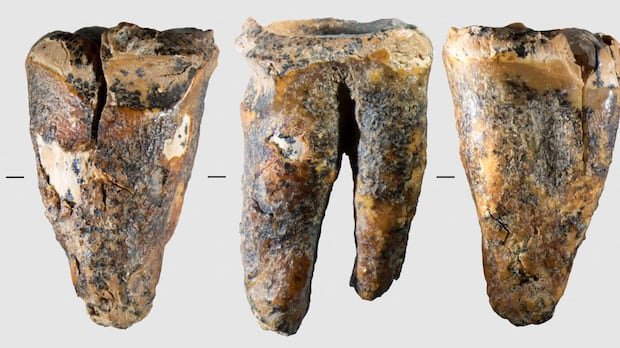
In a remote area of Siberia about 59,000 years ago, a Neanderthal faced a severe toothache and took action to alleviate the pain. Recent findings reveal a lower molar discovered in a cave near the Altai Mountains exhibiting signs of dental surgery – a significant cavity manually drilled with a stone tool to remove decay.
Published in the journal PLOS One, researchers highlight this as the earliest-known instance of invasive dental treatment, predating homo sapiens’ documented dental practices. This discovery further supports the notion that Neanderthals possessed more advanced skills than commonly believed.
Anthropologist John Olsen, a study co-author, speculates two scenarios for the tooth intervention. He suggests that the individual sought help due to unbearable pain or attempted self-treatment by drilling the cavity. However, the latter seems less probable given the social nature of Neanderthals.
While the presence of Neanderthal dentists is doubtful, experts propose the procedure might have been performed by a skilled practitioner. The fossil, found in Chagyrskaya Cave in Russia, reveals intentional modifications on the tooth, indicating a deliberate medical approach rather than accidental damage.
Comparative experiments on modern human teeth supported the findings, replicating the drilled hole using similar stone tools found at the cave. This discovery challenges previous assumptions, demonstrating Neanderthals’ advanced cognitive abilities and medical strategies.
Despite the lack of concrete evidence confirming the procedure as dental surgery, researchers argue persuasively for its plausibility. This early case of healthcare among Neanderthals adds to the evolving understanding of their sophistication beyond traditional perceptions.
Neanderthals, who disappeared approximately 40,000 years ago, have often been misrepresented in popular culture. Recent studies debunk stereotypes, showcasing their artistic, technological, and compassionate capabilities, including crafting tools, conducting burials, and providing medical care.
The significance of the Neanderthal tooth study lies not only in the potential medical expertise but in the communication skills required for such a procedure. The ability to convey the benefits of enduring temporary pain for long-term relief challenges stereotypical views of Neanderthals as primitive beings, emphasizing their complex nature.

