
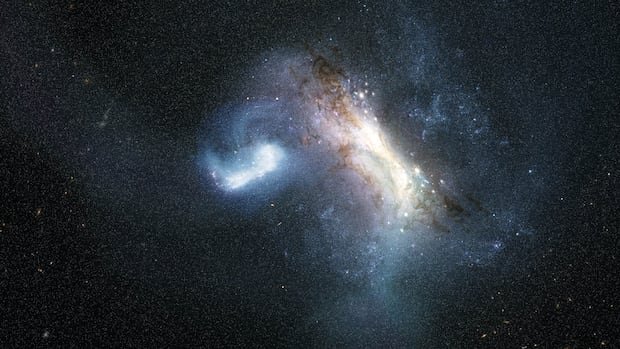

New research has shed light on the early history of the Milky Way galaxy, revealing that it underwent a significant event approximately 11.8 billion years ago. This event involved the merging of a smaller galaxy with the Milky Way, marking the galaxy’s earliest known galactic merger. The study indicates that the Milky Way’s growth was not only driven by its own star formation but also by the absorption of smaller galaxies that came within its gravitational reach.
The smaller galaxy involved in the merger was classified as a dwarf galaxy, distinguishing it from larger galaxies like the Milky Way. At the time of the merger, this dwarf galaxy was estimated to contain stars with a mass equivalent to 500 million times that of the sun, about a quarter of the size of the Milky Way at that time.
Scientists utilized the Hubble and Gaia telescopes to study clusters of stars near the center of the Milky Way, analyzing their age, chemical composition, and trajectory. These stars became part of the Milky Way following the merger, which occurred roughly two billion years after the Big Bang event that marked the beginning of the universe.
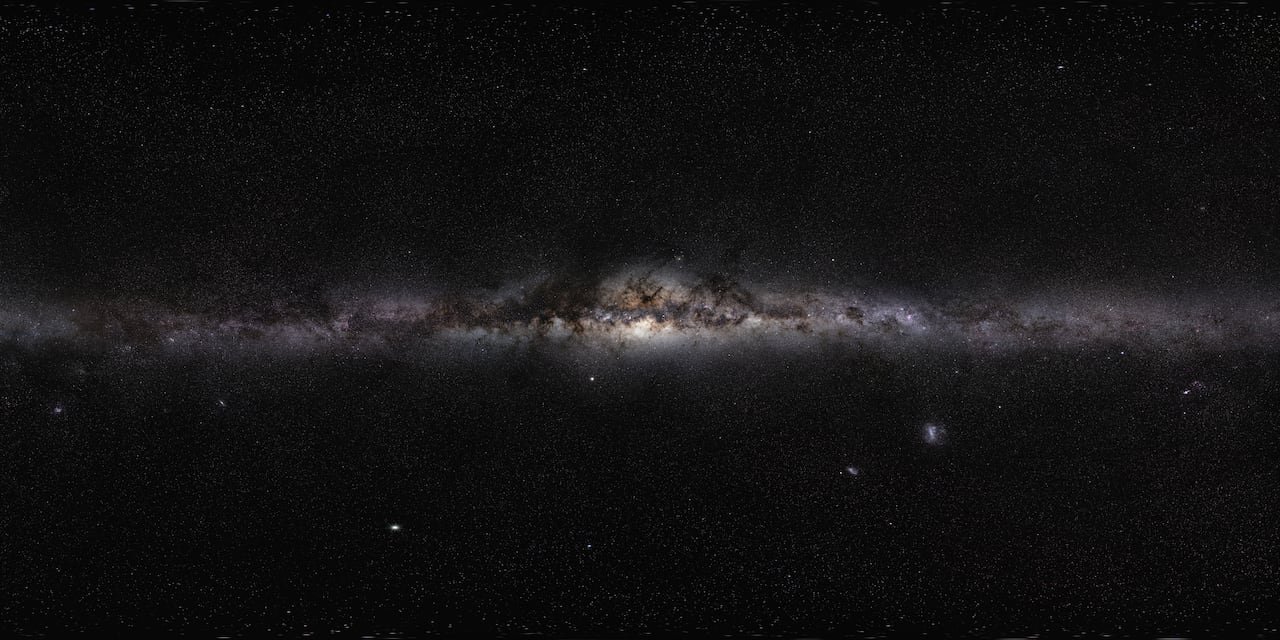
The dwarf galaxy involved in the merger was named Low-energy-Kraken-Heracles (LKH) by researchers. This discovery marks the first merger event experienced by the Milky Way in its early stages, according to lead author Davide Massari, an astrophysicist at the National Institute for Astrophysics in Bologna, Italy.
‘Peaceful’ Merger
There has been a debate over whether the Milky Way’s growth was primarily driven by internal star formation or by galactic mergers. The new study suggests that the merger injected a significant number of stars and interstellar gas into the Milky Way early in its history, fueling star formation and contributing to the presence of dark matter.
-
Astronomers reveal first photograph of a monster black hole at the heart of our galaxy
-
Milky Way was part of cosmic collision 10 billion years ago
According to Massari, the merger process was relatively peaceful in terms of star interactions but more turbulent in terms of gas dynamics. The collision between the gas from the dwarf galaxy and that of the Milky Way likely triggered the formation of numerous stars.
