
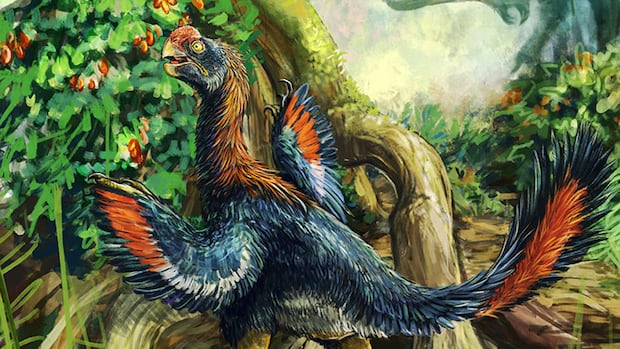
While various dinosaurs were crunching their prey’s bones with formidable teeth or methodically munching on leaves and branches, Infernogallus jamesi might have been delighting in the sweet offerings of nature.
This newly identified species, whose name means “hell chicken,” possessed a beak without teeth and a jaw formation that indicates a diet mainly consisting of fruits, as stated in a study published in Nature Communications.
Lead author of the study, paleontologist Greg Funston, shared with As It Happens host Nil Köksal, “This dinosaur was somewhat unexpected for us because we had long believed that dinosaurs were not consuming fruits.”
If the findings are accurate, it would classify the hell chicken as the first known fruit-eating dinosaur, though some researchers warn that additional evidence is required to substantiate this claim.
‘Probably quite vicious’
Infernogallus jamesi was a turkey-sized dinosaur that existed approximately 66 million years ago, cohabiting the Earth with creatures like Tyrannosaurus rex and Triceratops.
Belonging to the Caenagnathid family, which comprises bird-like dinosaurs with elongated beaks and feathered bodies, Funston characterized it as a mixture of an emu and a parrot, remarking that it was “likely quite aggressive in temperament.”
“Most individuals wouldn’t want to be trapped in an enclosure with a turkey,” stated Funston, who is an assistant professor at Stony Brook University in New York. “However, the name does not reflect its disposition or behavior.”

The term “hell chicken” actually derives from the Hell Creek Formation, the site where its fossil was uncovered in 2011. This region is now a rocky expanse that covers a large part of the western United States and sections of Canada. However, during the Cretaceous period, it was a verdant forest brimming with prehistoric life.
Paleontologist and author Riley Black, who was not part of the research, noted that the discovery is significant due to the rarity of complete Caenagnathid fossils.
-
Jerky-like skin of a 52,000-year-old woolly mammoth could change what we know about ancient DNA
-
Prehistoric puke reveals hunting (and hurling) habits of ancient ocean predators
“I have been anticipating a fossil like Infernogallus for quite some time,” Black mentioned in an email.
“Infernogallus provides us with our first glimpse of what a caenagnathid skeleton truly resembled in life, and even more intriguingly, it’s so unusual that paleontologists may have to reconsider how these dinosaurs lived.”
A toothless beak and a human-like jaw
According to Funston, the peculiar aspect of the hell chicken’s skeleton is its jaw.
He explained that most dinosaurs had jaws that operated in a “chewing motion primarily up and down.” This movement provided the necessary strength for carnivores to tear into their prey and enabled herbivores to grind through twigs, ferns, leaves, and branches.
However, this was not the case for the hell chicken.
“Rather than moving the jaws vertically, these muscles would pull them from front to back. This is a motion that feels familiar to us, similar to how we chew,” he remarked.
“This creature was processing something that was relatively soft, but required significant manipulation before it could be swallowed. To us, the only thing that fits this description is fruit.”
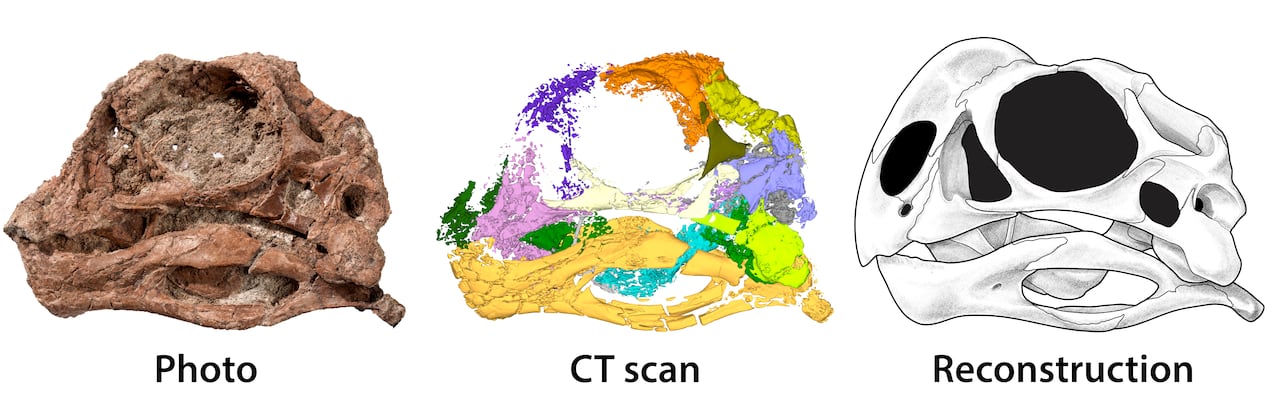
Researchers studied, scanned, and reconstructed the skull of Infernogallus jamesi, a.k.a, the ‘hell chicken.’ (Submitted by Greg Funston)
If their hypothesis holds true, it could clarify a long-standing mystery for paleontologists.
About 130 million years ago, flowering plants began to appear on Earth, replacing the previous cone-bearing flora, and offering a wealth of fruit for animals to consume.
Birds — which are essentially dinosaurs — were early adopters of fruit consumption. Research indicates they have been enjoying fruits for at least 120 million years.
Nonetheless, until this point, there has been scant evidence that non-avian dinosaurs incorporated fruit into their diets as a staple.
“For an extended period, we were struggling to understand how dinosaur evolution aligned with this significant change,” Funston commented.
Evidence ‘circumstantial,’ cautions scientist
However, the proof that the hell chicken specialized in fruit consumption remains “circumstantial at this time,” Black cautioned.
“When examining dinosaur skeletons, there is always a tension between what a dinosaur might have done and what it actually did,” she explained.
“The beaky structure of Infernogallus and its size strongly suggest that this dinosaur was foraging for small bites and consuming comparatively soft foods. But what exactly?”
To confirm this, she noted that scientists would need to uncover direct evidence of fruit within the preserved remains of the creature’s stomach — a challenging task. The hell chicken would have to perish shortly after eating, become fossilized, and then be discovered in a relatively intact state.
“Such discoveries are quite rare and often necessitate extraordinary conditions along with a degree of luck,” she remarked. “The chance of finding any gut contents from any dinosaurs is quite fortunate.”
-
Researchers discover thousands of dinosaur footprints in Alaska
-
Scientists digitally rebuilt the brain of a 205M year-old dinosaur. Here’s what they found
Nevertheless, she asserts that the research marks an exciting initial step.
“This study will undoubtedly inspire further investigation and analysis of the interactions between plants and dinosaurs,” she stated.
“In paleontology, few findings ever represent the conclusive truth about how an animal that has been extinct for millions of years truly lived. The questions that arise keep us searching and debating, which is a remarkable aspect of the field.”

