
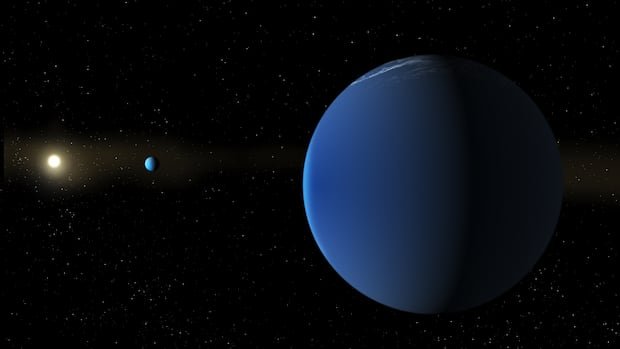
Antoine Petit, a mathematician at France’s Centre National de la Recherche Scientifique, discussed the intriguing discovery of two “super-puff” planets during an interview with As It Happens host Nil Koksal. These planets, located approximately 1,113 light years away from Earth and orbiting a single star, exhibit the size of Jupiter but possess the density akin to cotton candy.
The lead author of the study, University of Oxford astrophysicist George Dransfield, likened these rare exoplanets to a fluffy blob of shaving foam. The research, recently published in the Monthly Notices of the Royal Astronomical Society, sheds light on the enigmatic nature of these super-puffs, which defy conventional planetary mass-density relationships.
Super-puffs, a rare cosmic phenomenon with fewer than 40 confirmed instances among over 6,300 known exoplanets, present a significant scientific intrigue. Lisa Dang, an astrophysicist at the University of Waterloo, emphasized the uniqueness of discovering two super-puffs around the same star, highlighting the complexity of these celestial bodies.
According to Nicolas Cowan, a professor at McGill University, the existence of super-puff planets challenges existing planetary formation theories. Theories suggest that these planets may be young and hot, leading to their inflated size and low density. Alternatively, they could be sustained by internal heat sources like tidal heating.
Detected by NASA’s Tess satellite, these super-puff planets, named TOI-791 b and TOI-791 c, orbit a star in the constellation Volans. Follow-up observations by NASA’s Webb Space Telescope are expected to confirm the composition of these planets, suspected to be predominantly hydrogen and helium.
Despite the ongoing research and calculations by scientists, Cowan emphasized the need for further investigation to validate the findings. The sibling relationship between these planets, as described by Petit, offers a unique opportunity to study their gravitational interactions and evolutionary dynamics, potentially unveiling profound insights into planet formation.
As researchers delve deeper into the mysteries of these super-puff planets, the scientific community anticipates significant revelations that could revolutionize our understanding of planetary evolution and celestial phenomena.

