
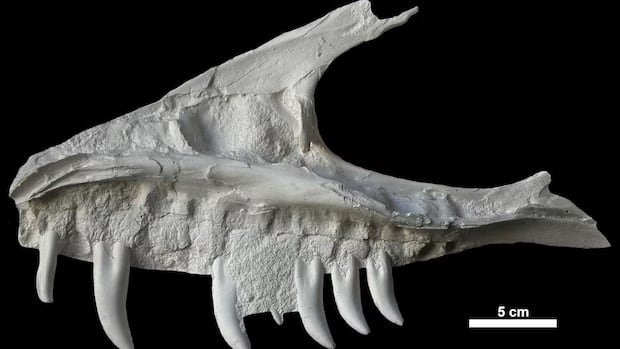
A recent study revealed that a dinosaur skull discovered at a British Columbia campground belonged to a lighter and faster tyrannosaur species called Gorgosaurus, distinct from the well-known T. rex. Researchers from the University of Alberta analyzed a cast of a partial skull impression dating back 76 million years, shedding new light on the ancient creatures that once inhabited Western Canada.
Lead author Colton Coppock explained that they identified Gorgosaurus based on unique characteristics found in the impression. The Royal Tyrrell Museum in Alberta mentioned that this species could grow up to nine meters in length.
The journey to uncovering the dinosaur’s identity began in 2017 when Rick Lambert, a B.C. resident, stumbled upon a peculiar rock at a Tumbler Ridge campground. Lambert, with a childhood background in fossil hunting, noticed the rock near a river’s edge, thanks to a squirrel’s guidance. The Tumbler Ridge Museum Foundation confirmed that Lambert had unearthed B.C.’s first tyrannosaurus skull.
The skull impression contained the dinosaur’s upper jaw, known as the maxilla, with most of the actual bone eroded away but well-preserved enough to create a detailed cast capturing its unique features. Coppock and his team determined that the discovered skull likely belonged to Gorgosaurus libratus, a species that roamed the Earth 76 million years ago, predating the T. rex by about 10 million years.
Gorgosaurus, characterized by triangular horns above its eyes, had a lighter build and longer limbs compared to the T. rex, making it a swifter predator. The researchers compared the cast to more complete Gorgosaurus skull bones, aided by clues like bone sutures and unique jaw openings.
The study also revealed that Gorgosaurus had a broader geographic range than previously believed, covering an area akin to the territory of grizzly bears and cougars today, spanning from northern British Columbia to northern Montana, totaling around 198,000 square kilometers.
Lambert’s discovery hints at British Columbia’s potential as a significant hub for future dinosaur findings, positioning the province as a new frontier for paleontological research. Coppock emphasized the importance of Lambert’s find, not just as a scientific breakthrough but as a testament to the enduring history of life on Earth.

