
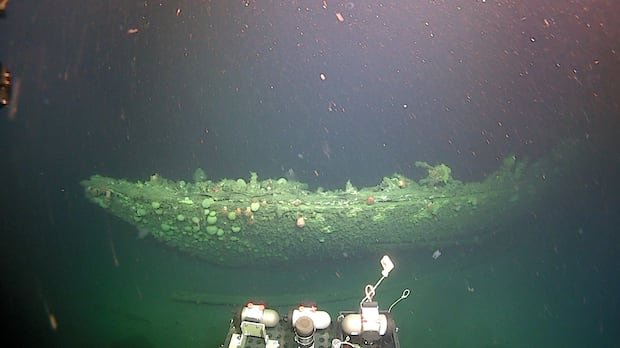
After spending 80 years at the bottom of the Labrador Sea, the Terra Nova now appears drastically altered from its days carrying renowned British explorer Robert Falcon Scott to the South Pole. Describing the wreck as in poor condition yet intriguing, David Mearns, co-chief scientist of a Canadian-led expedition, highlighted the significance of documenting the ship, which was discovered in 2012 off the coast of Greenland.
The expedition, which also recently explored the wreck of the Quest, the vessel that transported explorer Sir Ernest Shackleton on his final Antarctic journey, is utilizing remotely operated vehicles (ROVs) and an underwater submersible to examine these historic shipwrecks.
Using advanced technology developed by Voyis, based in Waterloo, Ontario, the researchers onboard the research ship Atlantis employed an ROV to map the Terra Nova wreck. Submerged under 170 meters of water approximately 30 kilometers south of Greenland since its sinking in 1943, the Terra Nova’s double wheels, rudder, boilers, and steam winches remain visible, providing a fascinating glimpse into the past.
The Voyis technology not only captures images and videos but also creates three-dimensional maps of the entire ship, offering marine biologist Kirstin Meyer-Kaiser a comprehensive context for her research. The detailed 3D model enhances the scientific understanding of the wreck and provides valuable data for future investigations.
Dwight Coleman, co-chief scientist and director of ocean imaging at the Woods Hole Oceanographic Institution in Massachusetts, emphasized the significance of the expedition’s detailed study of these northern shipwrecks in advancing scientific knowledge and technological capabilities.
Meyer-Kaiser’s research also focuses on the marine life that has colonized the Terra Nova wreck, noting the presence of fish, particularly redfish, which have made the ship their habitat. By studying the interactions between human-made structures like shipwrecks and marine ecosystems, she aims to better predict the impacts of future human activities in the oceans.
John Geiger, president of the Royal Canadian Geographical Society leading the expedition, sees the exploration of the Terra Nova and Quest as a symbolic return to the pioneering spirit of exploration embodied by Scott and Shackleton. Reflecting on the historical significance of these expeditions, Geiger highlighted the invaluable lessons to be learned from their experiences using cutting-edge oceanographic technology today.

