
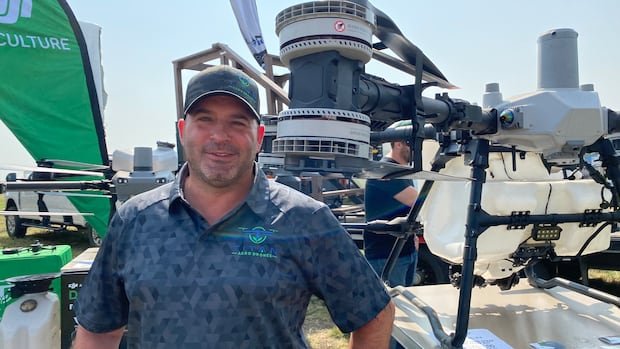
Last year, sales representative Ryan Crumly had foreseen an impending surge in farmers embracing drone technology once the authorization to use them for spraying insecticides and fungicides on crops was granted. His prediction appears to have materialized.
In late June, Health Canada removed its restrictions, permitting drones to apply approved pesticides, prompting a rush among farmers to adopt this technology. Crumly, employed by Titan Aero Drones, remarked that this policy change had led to an overwhelming demand, with nearly 80 drones selling out within days.
Farmers and drone retailers alike have embraced this policy revision, citing the superiority of drones over ground sprayers and planes in terms of efficiency. Many farmers are considering purchasing a pesticide-spraying drone in the near future.
Praised as a cutting-edge technology with numerous advantages, pesticide-spraying drones offer advantages over traditional aircraft due to their ability to operate day and night and navigate challenging terrains like trees and powerlines. Additionally, flooded fields hindering ground sprayers have prompted interest from farmers in utilizing drones.
These drones are user-friendly, allowing farmers to program the spraying route and parameters, after which the drone operates autonomously, requiring minimal intervention from the operator. Greg Hill, a farm operator from southeast Saskatchewan, expressed optimism about the significant impact drones could have in agriculture.
Unlike ground sprayers that can damage crops while working, drones offer precision and efficiency without causing trampling losses. The cost of spray drones, although high, is comparably lower than that of ground sprayers, with operational expenses also significantly reduced.
Despite the benefits, the price remains a major consideration for farmers like Hill and Raymond Phillips. Additional costs for equipment, licensing, and training must be factored in. However, both Hill and Phillips foresee themselves investing in drones within the next few years, highlighting the evolving nature of this technology.
In conclusion, the adoption of pesticide-spraying drones in agriculture is on the rise, driven by their effectiveness, cost-efficiency, and technological advancements.
[End of rewritten article]

