
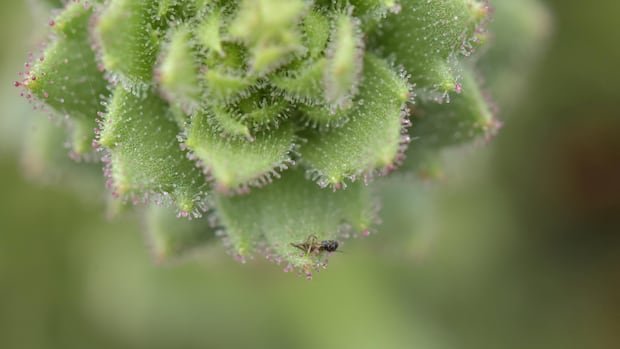
Botanist Douglas Soltis recently shared insights in an interview revealing a groundbreaking discovery that validates a theory proposed by Charles Darwin over a century ago. The research identifies Saxifraga candelabrum, a seemingly harmless flowering plant in southwestern China, as a carnivorous species that ensnares and consumes unsuspecting insects using its adhesive hairs.
The study, published in the journal Nature Communications, confirms Darwin’s speculations made 151 years ago about predatory traits within the Saxifraga genus. These plants, including the one under scrutiny, feature tiny sticky hairs exuding a sweet scent that attracts insects, leading to their entrapment. This phenomenon intrigued Darwin when he observed insects adhered to European Saxifraga plants in 1875.
To substantiate the carnivorous nature of Saxifraga candelabrum, researchers conducted experiments with fruit flies fed nitrogen-enriched food, as these mountain plants primarily seek nitrogen for nourishment. Peter Ryser, a plant ecologist, posits that such plants likely evolved from deterring bug consumption of their seeds to utilizing insects as nutrient sources.
Despite the need for nutrients, plants also require pollinators, a balance achieved by Saxifraga candelabrum by selectively trapping smaller insects while allowing larger pollinators to remain unaffected. This study suggests the existence of more undiscovered carnivorous plants, possibly within Darwin’s favored Saxifraga genus.
The botanical community’s continuous exploration into carnivorous plant behavior unveils intriguing adaptations, furthering our understanding of nature’s diverse mechanisms for sustenance and evolution.

