
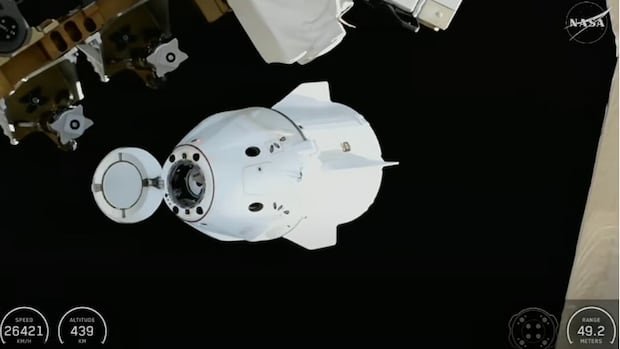
A deterioration in air pressure on the International Space Station led to five astronauts seeking shelter and preparing for possible evacuation for about two hours on Friday while Russian crew members worked to address a crack on their part of the station, NASA reported. The four members of the Crew-12 mission, which includes two Americans, a French astronaut, and a Russian cosmonaut, were instructed by NASA at 9:04 a.m. ET to enter their SpaceX-made Crew Dragon spacecraft attached to the station. The astronauts were later allowed to return to the station as NASA and Russian officials assessed the air leakage situation.
NASA and Russia’s Roscosmos have been investigating and discussing solutions for some time regarding small air leaks in the Zvezda service module of the ISS. The first leak was identified during Expedition 63 in 2020, and efforts have been ongoing to address it. On Friday, Roscosmos confirmed detecting two leaks but assured that there was no immediate danger to the crew.
Following the sealing of the first leak, efforts were being made to address the second one, with no reported impact on the spacecraft’s systems. The rate of air leakage increased from one pound per day to two pounds, causing concerns among officials. The ISS currently houses seven astronauts from two missions, with the Crew-12 team, comprising NASA astronauts and cosmonauts, arriving in February.
While preparations were being made to address the second leak, disagreements arose between Roscosmos and NASA on the approach to fixing it. The potential use of a saw by two cosmonauts to access the crack prompted NASA to issue safe-haven orders as a precaution. Safe-haven protocols are rarely activated on the ISS, emphasizing crew safety and preparedness for any emergency situations.
NASA expressed its commitment to collaborating with Roscosmos to address the leaks effectively. Despite occasional challenges like air leaks and debris risks, the ISS has never had to undergo an evacuation in its history. Efforts are underway in the U.S. Congress to extend the lifespan of the space station until 2032 to allow for the development of a replacement.
Legislation supported by key senators aims to prolong the ISS’s operational life and enhance U.S. competitiveness in space exploration. Congressional leaders are working to finalize the legislation to support the country’s space initiatives and counter China’s expanding space capabilities.

