
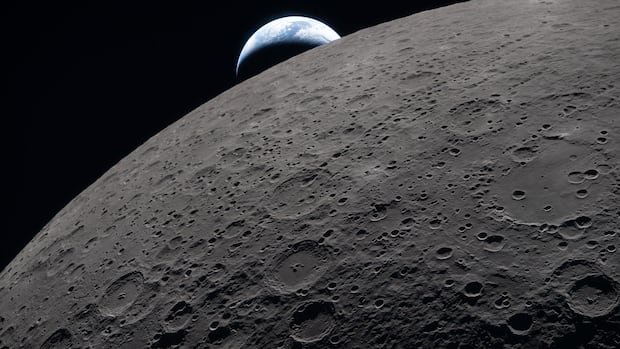
The crew of Artemis II is on their way back home after an extraordinary lunar experience. Astronauts Jeremy Hansen from the Canadian Space Agency, along with NASA’s Reid Wiseman, Victor Glover, and Christina Koch, set a new milestone by venturing farther from Earth than any previous humans during the Artemis II mission. While satellites have captured images of the moon’s far side since 1959, this mission marked the first time humans directly observed certain far-side regions.
Kelsey Young, the lunar science lead for Artemis II at NASA, expressed excitement about the opportunity for astronauts to visually inspect and describe lunar features. During a media conference, Young highlighted the ability of the human eye, especially when accompanied by a well-trained brain, to make detailed color observations rapidly.
The astronauts spent five hours making observations using cameras and their naked eye. They provided detailed descriptions of what they saw, focusing on areas like the Orientale basin and color variations near Hertzsprung crater on the moon’s far side.
Despite the common perception of the moon as monochrome, it exhibits various colors due to minerals on its surface. Unlike cameras that require saturation adjustments to reveal these colors, the human eye is naturally sensitive to subtle differences in color and brightness.
Ralph Chou, a professor emeritus at the University of Waterloo, emphasized the eye’s superior ability to discern visual details compared to electronic systems. He explained that human vision, enhanced by the eye’s photoreceptors and visual system, excels at detecting nuances that machines may miss.
Moreover, real-time, three-dimensional viewing enhances the human experience of observing lunar features. During the flyby, the crew also witnessed meteoroids striking the moon’s surface, a phenomenon rarely seen on Earth due to atmospheric interference.
Peter Brown, a meteor astronomer, highlighted the advantage of human observations in capturing transient events like impact flashes. While cameras are valuable for studying lunar features, combining visual observations with technological data enhances our understanding of the moon.
NASA officials, including Jacob Bleacher, expressed enthusiasm for the crew’s descriptions and emphasized the scientific value of their observations. As higher resolution images become available, researchers anticipate gaining deeper insights into the moon’s surface features and enhancing their understanding of Earth’s celestial companion.

