
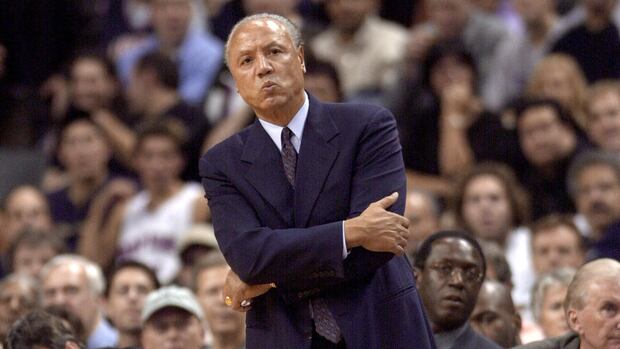
Lenny Wilkens, a revered figure in basketball who was inducted into the Basketball Hall of Fame three times as both a player and a coach, has passed away, according to his family on Sunday. He was 88 years old.
The family shared that Wilkens was with his loved ones at the time of his passing, although they did not disclose the cause of death immediately.
Wilkens was celebrated as one of the greatest point guards of his time and later transitioned to coaching, where he brought his composed and insightful approach to the sidelines, first as a player-coach before becoming one of the most respected coaches in the sport.
He holds the record for coaching 2,487 games in the NBA. Wilkens was honored as a Hall of Famer as a player, a coach, and as a member of the 1992 U.S. Olympic team, where he served as an assistant. He also led the U.S. team to a gold medal at the Atlanta Games in 1996.
From 2000 to 2003, Wilkens coached the Toronto Raptors, guiding them to two playoff seasons.
“Lenny Wilkens epitomized the very essence of the NBA — as a Hall of Fame player, a Hall of Fame coach, and one of the sport’s most esteemed ambassadors,” stated NBA Commissioner Adam Silver on Sunday. “His legacy was further cemented when he was named one of the league’s 75 greatest players and 15 greatest coaches of all time four years ago.”
As a player, Wilkens was a nine-time All-Star and the first NBA coach to achieve 1,000 wins. He was also the second individual to be inducted into the Basketball Hall of Fame both as a player and a coach. Wilkens led the Seattle SuperSonics to an NBA championship in 1979, remaining a beloved figure in the city, often regarded as a godfather of basketball in Seattle, which lost the Sonics to Oklahoma City in 2008 and has been striving to regain an NBA team since.
He approached everything with dignity, a quality he took pride in.
“Leaders don’t yell and scream,” Wilkens remarked to Seattle’s KOMO News earlier this year.
Wilkens, who was named the NBA coach of the year in 1994 while with Atlanta, concluded his career with 1,332 coaching victories, a mark that was later surpassed by Don Nelson and Gregg Popovich.
Godfather of Seattle basketball
Wilkens had a 15-year playing career with the St. Louis Hawks, SuperSonics, Cleveland Cavaliers, and Portland Trail Blazers. He was a five-time All-Star during his time with St. Louis, a three-time All-Star in Seattle, and he earned one All-Star selection with Cleveland in 1973 at the age of 35. A statue commemorating his contributions to the SuperSonics was unveiled outside Climate Pledge Arena in June.
“Beyond his impressive basketball achievements, including two Olympic gold medals and an NBA championship, what stood out was his dedication to service — particularly in his cherished community of Seattle, where a statue honors him,” Silver stated. “He positively impacted countless young lives, as well as generations of players and coaches who viewed Lenny as not just a great teammate or coach but also an exceptional mentor who exemplified integrity and class.”
Wilkens led the league in assists on two occasions but was also a notable scorer, averaging double figures in scoring throughout nearly all his seasons, except for his final one in 1974-75 with the Trail Blazers. His peak scoring season occurred in 1968-69 with the SuperSonics, where he averaged 22.4 points, 8.2 assists, and 6.2 rebounds.
Leonard Wilkens was born on October 28, 1937, in New York City. He honed his basketball skills on the playgrounds of Brooklyn and at a prominent city school, Boys High School, where he played alongside future major league baseball star Tommy Davis. He later excelled at Providence College and was selected by the Hawks as the sixth overall pick in the 1960 NBA Draft.
Hall of Fame player, Hall of Fame coach
Wilkens’ accomplishments as a player alone would have warranted his Hall of Fame consideration, but his coaching achievements — marked by both success and longevity — truly solidified his legacy.
He received numerous other accolades, including induction into the FIBA Hall of Fame, the U.S. Olympic Hall of Fame, the College Basketball Hall of Fame, the Providence Hall of Fame, and the Cleveland Cavaliers’ Wall of Honor.
His coaching career included two separate tenures in Seattle, totaling 11 seasons, as well as two seasons in Portland — during which he also played, averaging 18 minutes per game — seven seasons in both Cleveland and Atlanta, three seasons with Toronto, and parts of two years with the Knicks.
Despite holding the record for the most losses in NBA coaching history with 1,155, his achievements far outweighed the challenges. He led the SuperSonics to their only championship with a victory over the then-Washington Bullets, a year after being defeated by them in the Finals.
Wilkens ascended to the top of the wins list on January 6, 1995, while coaching the Hawks, surpassing Red Auerbach’s record with his 939th victory. He became the first coach to reach 1,000 career wins, a milestone later achieved by nine others.
Player-coach in 1969
The idea of simultaneously playing and coaching was proposed before the 1969 season while Wilkens was at the home of SuperSonics general manager Dick Vertlieb, enjoying a casual game of pool.
“I thought he was crazy,” Wilkens recounted. “I kept putting him off, but he was persistent. Eventually, as training camp approached, I thought, ‘What the heck, I’ll give it a shot.’”
From that moment, his passion for coaching began to grow.
During a game where Seattle was trailing the Cincinnati Royals by four points with seconds left, Wilkens devised a play that led to a dunk. He instructed his players to press, knowing the Royals were out of timeouts. The Sonics stole the inbounds pass, scored again to tie the game, and ultimately triumphed in overtime.
“I was like, ‘Wow!’” Wilkens exclaimed. “I had just done something as a coach that helped us win, not just as a player.”
After retiring from coaching in 2005, Wilkens returned to the Seattle area, where he spent every offseason. He managed his foundation for many years, primarily benefiting the Odessa Brown Children’s Clinic in Seattle’s Central District.
He also took on a role with the SuperSonics in 2006 as vice chairman, but left the position a year later when it became clear that new owner Clay Bennett intended to relocate the team from Seattle.
Wilkens is survived by his wife, Marilyn; their children, Leesha, Randy, and Jamee; and seven grandchildren.

