
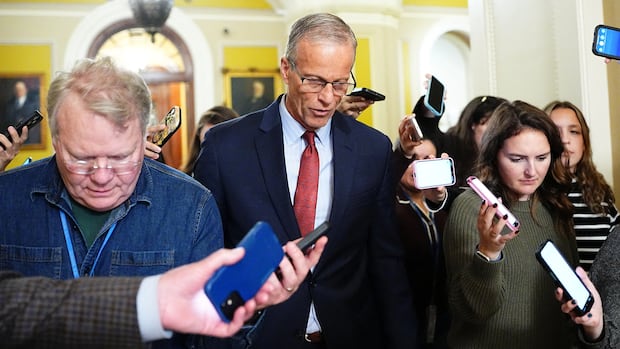

On Sunday, the U.S. Senate initiated the process to resolve the ongoing government shutdown after a coalition of moderate Democrats consented to advance without a guaranteed extension of health-care subsidies. This move has incited frustration among many within their party, who argue that Americans expect them to persist in their advocacy.
In a preliminary vote, which is the first of several necessary procedural steps, the Senate approved a motion with a 60-40 tally to progress toward enacting compromise legislation aimed at funding the government and scheduling a future vote on the Affordable Care Act tax credits set to expire on January 1. If Democrats raise objections and impede the procedure, final approval may be delayed for several days.
This agreement does not ensure the continuation of Affordable Care Act subsidies, despite nearly six weeks of demands from Democrats. Chuck Schumer, the Democratic Senate Minority Leader from New York, voted against advancing the package, joined by all but eight of his fellow Democrats.
A trio of former governors—New Hampshire Senators Jeanne Shaheen and Maggie Hassan, along with Maine Independent Senator Angus King—ended the six-week impasse on Sunday by agreeing to support the advancement of three bipartisan annual appropriations bills while extending government funding until late January. In exchange, they secured a commitment for a mid-December vote on the health-care tax credits.
Widespread flight cancellations
The agreement also entails reversing the mass layoffs of federal employees initiated by the Trump administration since the shutdown commenced on October 1, ensuring that federal workers will receive back pay.
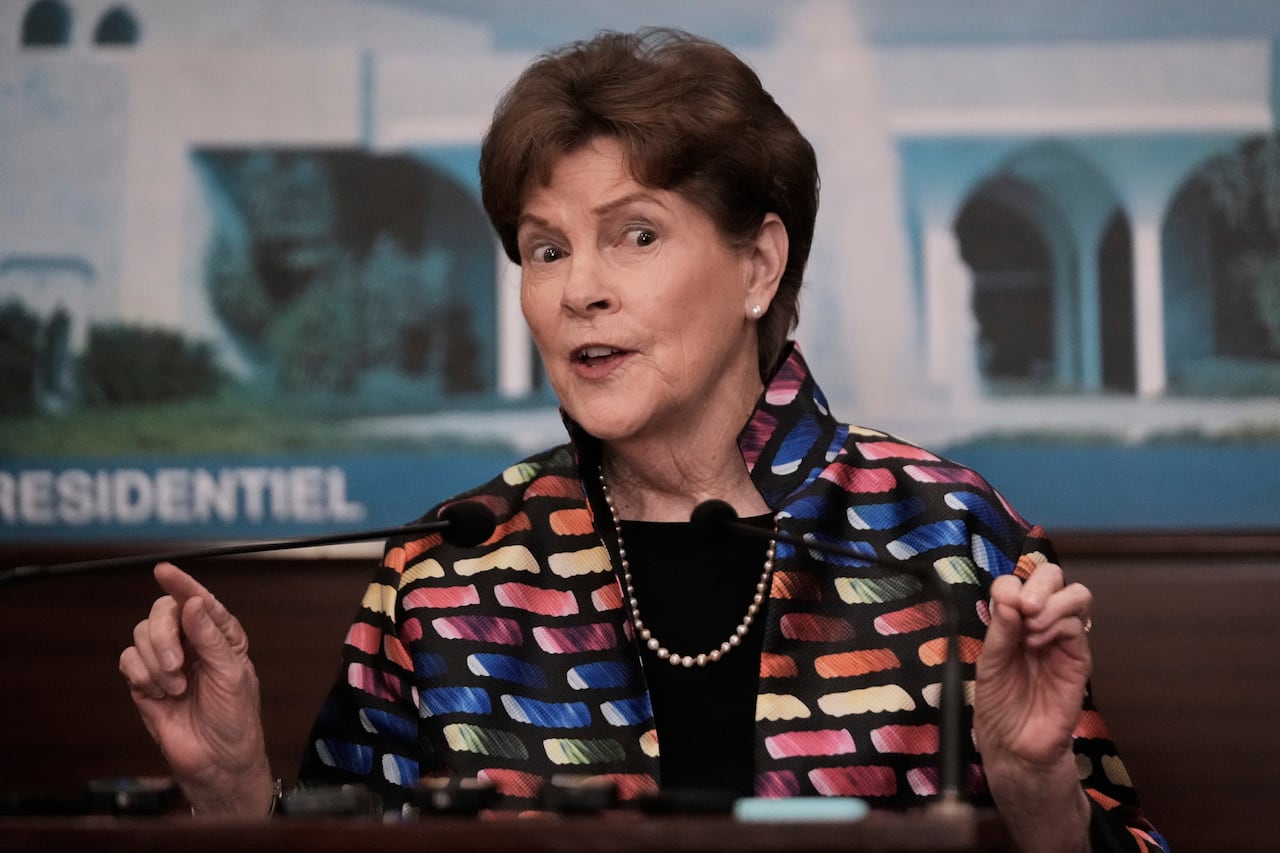
The trio of former governors, including New Hampshire Democratic Senator Jeanne Shaheen, played a pivotal role in breaking the six-week deadlock on Sunday. (Hussein Malla/The Associated Press)
Senate Majority Leader John Thune quickly backed the agreement and called for an immediate vote to initiate the approval process as the shutdown continued to disrupt flights across the nation, jeopardize food assistance for millions, and leave federal employees unpaid.
“The time to act is now,” Thune remarked.
Upon returning to the White House Sunday evening after attending a football game, President Donald Trump did not clarify his stance on the agreement. However, he did mention, “It looks like we’re getting close to the shutdown ending.”
In addition to Shaheen, King, and Hassan, Democratic Senator Tim Kaine from Virginia, which is home to numerous federal workers, also supported advancing the agreement. Illinois Senator Dick Durbin, Pennsylvania Senator John Fetterman, and Nevada Senators Catherine Cortez Masto and Jacky Rosen also voted in favor.
The moderates had anticipated a greater number of Democrats would align with them, given that around 10-12 Democratic senators participated in the negotiations. Ultimately, however, only five Democrats changed their votes—the precise number Republicans required. King, Cortez Masto, and Fetterman had consistently supported efforts to reopen the government since October 1.
The vote experienced a temporary hold on Sunday evening when three conservative senators, Mike Lee from Utah, Rick Scott from Florida, and Ron Johnson from Wisconsin, who often critique spending measures, withheld their votes and conferred with Thune at the back of the chamber. They ultimately voted yes after discussions with Trump, according to Lee.
Another Republican, Senator John Cornyn of Texas, had to return from Texas to cast the critical 60th vote.
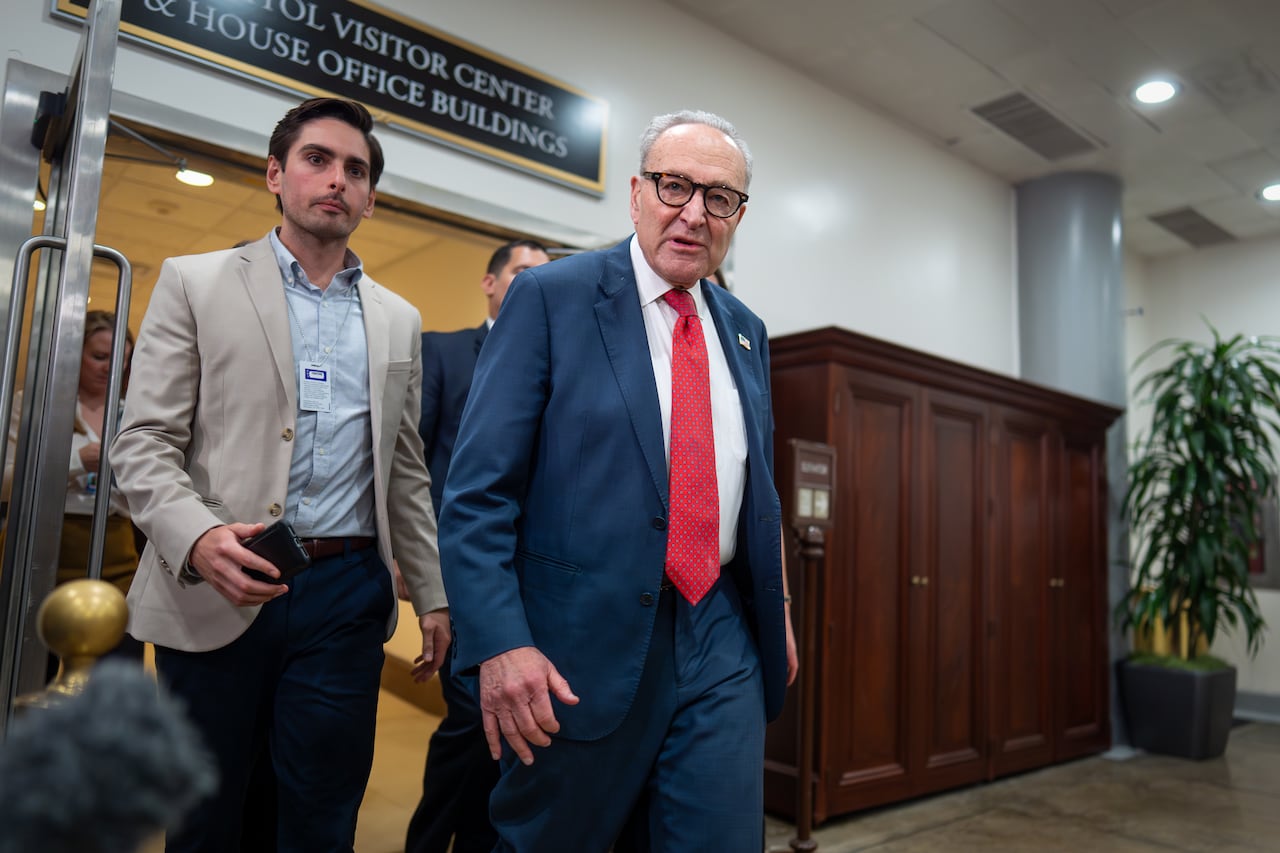
Senate Minority Leader Chuck Schumer, D-N.Y., stated he could not support the proposal to end the government shutdown “in good faith.” (J. Scott Applewhite/The Associated Press)
After a two-hour discussion among Democrats regarding the proposal, Schumer expressed that he could not “in good faith” endorse it.
Schumer, who faced backlash from his party in March for voting to keep the government open, asserted that Democrats have now “sounded the alarm” on health care.
“We will not give up the fight,” he declared.
Independent Senator Bernie Sanders from Vermont, who aligns with the Democrats, indicated that conceding was a “horrific mistake.”
Senator Chris Murphy from Connecticut echoed this sentiment, asserting that voters in last week’s elections overwhelmingly supported Democrats “to urge Democrats to hold firm.”
Republicans have been collaborating with the moderate group as the shutdown continued to disrupt nationwide flights, threaten food assistance for millions, and leave federal employees unpaid. However, numerous Democrats have cautioned their colleagues against capitulating, insisting they cannot conclude the fight without a commitment to extend health subsidies.
Upon returning to the White House on Sunday evening after attending a football game, U.S. President Donald Trump did not clarify his stance on the agreement but stated, “It looks like we’re getting close to the shutdown ending.”
A bipartisan agreement
Democrats have cast votes 14 times against reopening the government, insisting on the extension of tax credits that enhance affordability for health plans under the Affordable Care Act. Republicans have refrained from discussing health-care subsidies while the government remains closed, yet they have shown support for the proposal from moderate Democrats as it has developed over recent days.
The agreement would finance certain government functions—such as food aid, veterans programs, and the legislative branch—while extending funding for other areas until the end of January. It would accept Republicans’ longstanding offer to conduct a future vote on health-care subsidies, with this vote anticipated by mid-December, according to sources familiar with the agreement.

The agreement would reinstate federal employees who had received layoff notifications and reimburse states that utilized their own funds to maintain federal programs during the shutdown. Additionally, it would safeguard against future layoffs through January, according to sources, and ensure all federal workers would receive payment once the shutdown concludes.
“I have repeatedly said that in order to earn my vote, we need to be on a path to address Republicans’ health care challenges and to support the federal workforce,” Kaine stated.
Along with the funding resolution, Republicans released the final legislative text for three full-year spending bills on Sunday. This legislation maintains a prohibition on pay increases for lawmakers while enhancing their security budget by $203.5 million in response to increased threats. It also includes a provision advocated by Republican Senator Mitch McConnell of Kentucky to restrict the sale of certain hemp-based products.
Democratic pushback expected
Given that Republicans require just five votes from Democrats to reopen the government, a small number of senators could effectively end the shutdown with only a commitment for a future vote on health care. Approximately 10 to 12 Democrats have engaged in discussions, and three sources familiar with the agreement indicated they possess enough votes to collaborate with Republicans and pass the proposal.
However, many of their Democratic peers contend that the developing deal falls short.
“I genuinely wanted to secure something regarding health care,” remarked Michigan Senator Elissa Slotkin. “I’m going to hear about it immediately, but it seems like it lacks any concrete provisions.”
House Democrats have also voiced their opposition to the agreement. Texas Representative Greg Casar, the leader of the congressional progressive caucus, stated that an agreement that does not lower health care costs constitutes a “betrayal” of millions of Americans who are relying on Democrats to advocate for them.
“Accepting nothing but a pinky promise from Republicans isn’t a compromise — it’s capitulation,” Casar declared in a post on X. “Millions of families would bear the consequences.”
Representative Angie Craig from Minnesota remarked that if anyone perceives this as a “deal,” she has a bridge to sell them.
