
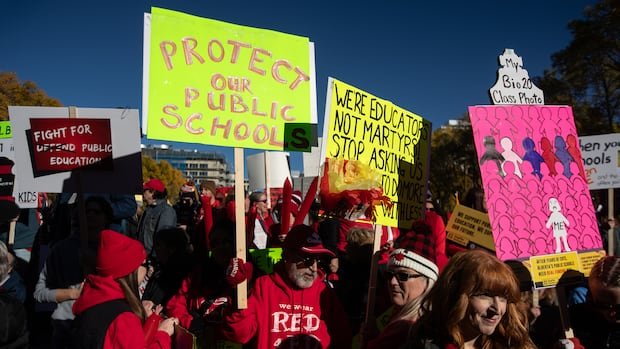
The Alberta government, according to Education Minister Demetrios Nicolaides, plans to cap new spending at $2.6 billion over four years to resolve a contract dispute with striking teachers. Nicolaides emphasized the importance of working within this financial limit to provide teachers with wage increases and address classroom complexities.
In response to a rejected contract offer that would have added $2.6 billion to the province’s expenses between 2024 and 2028, nearly 90% of Alberta Teachers’ Association (ATA) members voted against it. The offer included a 12% general wage increase, salary grid amalgamation in 2026 leading to potential 5% wage hikes for some teachers, and a commitment to fund 3,000 new teaching positions and 1,500 additional educational assistants.
The contract impasse resulted in 51,000 teachers going on strike, causing the closure of approximately 2,000 public, Catholic, and francophone schools across the province. The Teachers’ Employer Bargaining Association announced a lockout starting Thursday afternoon.
Nicolaides expressed the government’s openness to the ATA’s input on the required number of teachers to improve classroom conditions. However, he mentioned that exceeding the promised 3,000 new teaching positions would necessitate trade-offs within the offer.
While teachers have rejected a 12% salary increase offer twice, citing concerns about inflation adjustments and increased workloads, ATA President Jason Schilling highlighted the need for at least 5,000 more teachers to align with recommended class-size averages outlined in a 2003 Alberta Commission on Learning report.
Despite acknowledging the importance of class size, Nicolaides criticized class-size caps as arbitrary, suggesting that hiring more teachers and educational assistants and building more schools are key priorities to address classroom conditions. The ATA countered this viewpoint, emphasizing the significance of reasonable student-teacher ratios for student success.
Opposition voices, including NDP education critic Amanda Chapman, criticized the government for underfunding schools, leading to insufficient staffing and larger class sizes. Chapman stressed the need for greater funding to hire additional staff and improve the overall school experience for students.
While some provinces have implemented class-size caps or limits on students with complex needs, Alberta has not pursued such policies due to concerns about school space. The debate continues on the impact of class size on student academic performance and the broader goals of public education.

