
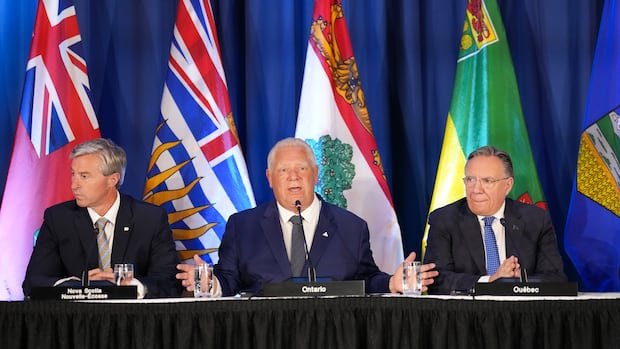
Five premiers are urging Ottawa to retract its recent proposal for restrictions on the notwithstanding clause, asserting that it contradicts the pact that gave rise to the Charter of Rights and Freedoms. The notwithstanding clause in the Constitution empowers provincial legislatures or Parliament to enact laws that supersede certain provisions of the Charter for a limited period of five years.
Ottawa’s stance, presented in a submission to the Supreme Court of Canada regarding Quebec’s secularism law, contends that constitutional boundaries on the notwithstanding clause prohibit its use to alter or negate the rights and freedoms safeguarded by the Charter. The federal submission emphasizes that the temporary nature of the notwithstanding clause confirms that it should not be utilized to cause irreversible harm to Charter rights.
In a letter addressed to Prime Minister Mark Carney, the premiers of Ontario, Quebec, Alberta, Saskatchewan, and Nova Scotia are calling on the federal government to reassess its position and retract its legal argument promptly. The premiers express concern that the federal arguments aim to impose new restrictions on the authority of democratically elected legislatures to employ the notwithstanding clause.
The premiers argue that Ottawa’s position undermines national unity by challenging the sovereignty of provincial legislatures, which they intend to raise for deliberation by the Council of the Federation due to its significant implications for Canadian federalism. They assert that the federal government’s stance constitutes a direct assault on the fundamental constitutional principles of federalism and democracy.
The attorney general of Quebec is the respondent in the Supreme Court case under discussion, with several other attorneys general participating as interveners. Justice Minister Sean Fraser emphasized that the case extends beyond its immediate issues, as the Supreme Court’s ruling will shape the future application of the notwithstanding clause by federal and provincial governments.
Ontario, in its submission to the Supreme Court, underscores the crucial role of the notwithstanding clause in Canada’s constitutional democracy, enabling elected representatives to prioritize laws of public interest over certain Charter provisions for a limited duration. Ontario also stresses that the notwithstanding clause should not be viewed as a flaw necessitating judicial reinterpretation.
Ontario Premier Doug Ford criticized the federal position, labeling it as “the worst decision” made by Carney and warning of dire consequences. Ford emphasized the supremacy of legislatures over judicial interference in matters that he believes should not be subject to court scrutiny.

