
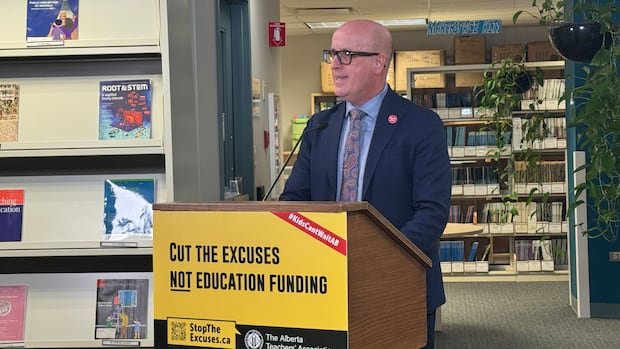
The head of the Alberta Teachers’ Association is advocating for the provincial government to finance class size guidelines established in 2003 after the province’s last significant teachers’ strike. ATA President Jason Schilling expressed on an episode of “Alberta at Noon” that the public, Catholic, and francophone school divisions in the province would have to recruit over 5,000 teachers to meet the recommended student-teacher ratios outlined in that report.
Schilling mentioned during the radio program that they are still waiting to see if the government would make a move on those figures, but it appears to be a low priority for them. These remarks came as 51,000 teachers are set to go on strike starting Monday.
The Alberta Commission on Learning (ACOL) was formed in response to concerns raised by educators regarding increasing class sizes following a 2002 strike involving 22,000 teachers across 22 Alberta school divisions. The commission not only proposed substantial additional education spending but also suggested target average class sizes for different grade levels.
According to the ACOL report, kindergarten to grade 3 classes should have an average of 17 children, grades 4-6 should have 23 students on average, junior high classes should aim for 25 students, and high school classes should have an average of 27 students.
The impact of class size on academic outcomes, especially in the early grades, has been extensively studied in education. The Alberta government ceased monitoring class sizes in 2019, but data from Edmonton Public Schools and feedback from various stakeholders indicate that many classes now exceed the recommended sizes.
Between 2020 and 2024, Alberta’s student population grew by 91,000, representing a 12% increase, with the total number of students enrolled last school year reaching 825,817. If teachers proceed with the strike on Monday, at least 730,000 students will experience class cancellations.
The dispute over class size and complexity, coupled with inadequate teacher salary adjustments relative to inflation, remains a key issue in the contract negotiations. All parties acknowledge the rising number of students with additional needs in Alberta schools in recent years.
Schilling emphasized that teachers are at a breaking point, seeing the current situation as unsustainable and in crisis. A recent contract offer rejected by nearly 90% of ATA members included a commitment from the government to fund 3,000 net new teaching positions and 1,500 additional educational assistant positions by August 2028.
Finance Minister Nate Horner indicated that while the government has the power to compel teachers back to work, they are not considering immediate back-to-work legislation. The Alberta legislature is scheduled to reconvene on October 23, with concerns about potential long-term educational harm if the situation escalates further.
Premier Danielle Smith mentioned that class size caps were unfeasible due to insufficient school infrastructure, prompting the government to invest $8.6 billion over seven years in the School Construction Accelerator Program to build new schools and upgrade existing facilities.
Education Minister Demetrios Nicolaides announced an additional $300 million commitment over three years to create more educational assistant positions in schools. Teachers have also turned down a mediator’s recommendation earlier this year, with salary increases and improving learning conditions for students being key demands.
Both Horner and Nicolaides expressed uncertainty about what offer teachers would find acceptable, with Schilling emphasizing the need for competitive wages and improved learning environments for students.

