
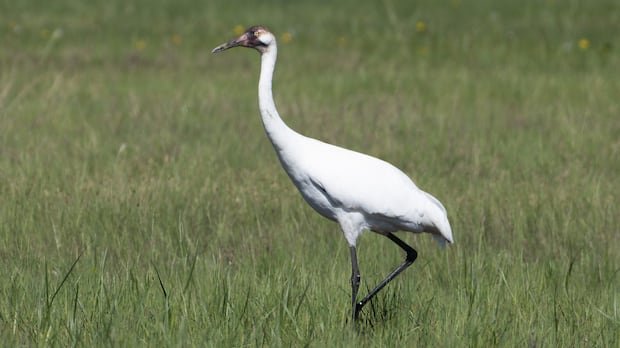
A striking five-foot-tall bird with brilliant white feathers caught the attention of Calgary birder Jonah O’Brien when news broke of a whooping crane sighting along a rural road northeast of the city. O’Brien, an experienced ornithologist who has cataloged over 270 bird species, was thrilled to witness this rare Canadian bird for the first time.
Typically, bird enthusiasts seeking whooping cranes in Canada venture to Saskatchewan during the fall migration season. Thus, the unexpected summertime appearance of the whooping crane in Kneehill County came as a delightful surprise to birders in the Calgary area.
The whooping crane, standing tall at five feet, holds the title of the tallest bird in North America. Distinguished by its size, all-white plumage, facial markings, and black wingtips visible in flight, the whooping crane is a remarkable sight.
The only remaining natural migratory flock of whooping cranes embarks on a 4,000-kilometer journey from their winter habitat in Texas to the remote wetlands of Wood Buffalo National Park for nesting each year. Currently, the flock of approximately 550 birds resides nearly 1,000 kilometers north of Calgary for the summer, within the park spanning the border with the Northwest Territories.
This particular whooping crane’s presence outside its usual habitat excites birdwatchers, who refer to such birds as “vagrants.” Beyond the novelty of its location, birdwatchers are also intrigued by the conservation success story represented by the whooping crane population. Once on the brink of extinction, the species has rebounded thanks to legal protections, habitat conservation efforts, and intensive captive breeding programs.
Although the wild whooping crane population has increased, the species remains endangered according to federal and provincial governments in Canada and the United States. Bird experts emphasize the importance of respecting the bird’s space and avoiding undue stress. This specific whooping crane is believed to be a non-breeding young bird, similar to other unusual sightings in the region in recent years.
McKinnon suggests that the crane may be enjoying southern Alberta for the summer, feeding and possibly continuing its migration next year, with the optimistic prospect of eventually reaching Wood Buffalo for breeding.

