
In April 2024, the highly anticipated celestial event was the total solar eclipse visible in Eastern Canada and the U.S. However, another eagerly awaited occurrence was the potential emergence of a new star in the sky known as T Coronae Borealis.
This particular star, sometimes called T Cor Bor, already exists but has not been visible to the naked eye. There were expectations that it would brighten enough to be seen without aid by the end of the year. Unfortunately, no significant new bright star materialized in the sky.
Brian Kloppenborg, an astrophysicist and executive director of the American Association of Variable Star Observers (AAVSO), highlighted the challenges surrounding T Cor Bor. Despite extensive studies of the system, uncertainties persist regarding its physics.
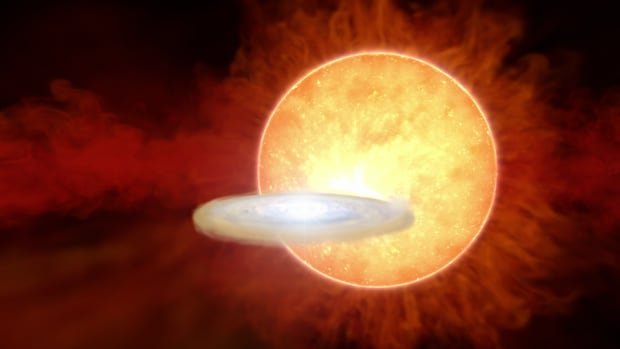
T Cor Bor is located approximately 3,000 light years away and is part of a binary system in the Corona Borealis constellation. It consists of a large red giant star and a compact white dwarf star. As the stars orbit each other, material from the red giant transfers to the white dwarf, leading to a buildup that eventually triggers a thermonuclear explosion, or nova, brightening the star to naked-eye visibility.
This eruption cycle occurs roughly every 80 years, with the last event recorded in 1946. Kloppenborg noted discrepancies in the expected accretion rate and material flow onto the star, delaying the predicted eruption.
Historically, T Cor Bor exhibits periods of increased activity followed by a quiet phase before an eruption, with signs of an imminent event observed since 2014, aligning with the 2024 prediction. Astronomer Brad Schaefer, who has studied T Cor Bor extensively, expressed confidence in an upcoming eruption despite past false alarms based on light curve fluctuations.
Recent research suggests potential eruption dates, with one paper proposing dates in 2024 and 2025. Conversely, another study indicates a possible deviation of up to 10 years from the 80-year cycle.
Amateur astronomers remain engaged in monitoring T Cor Bor, providing valuable observations. Once the star erupts, it will briefly brighten significantly before gradually dimming, becoming visible to the naked eye for a couple of days.
Despite the delay in T Cor Bor’s eruption, astronomers are prepared for the event, closely monitoring the star’s activity for any sudden changes that may indicate an imminent nova. The continuous observations by dedicated enthusiasts demonstrate unwavering interest and commitment to understanding this celestial phenomenon.

