
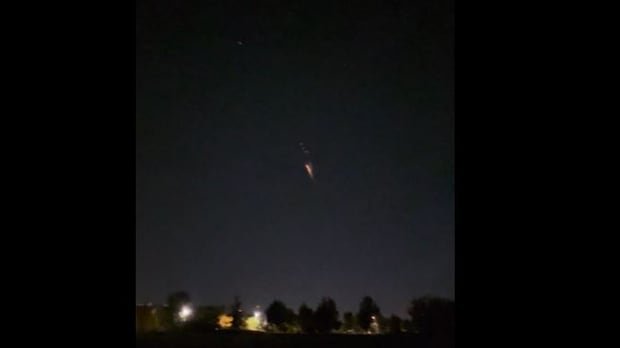
Cody Koloski gazed at the sky on Monday night, anticipating a display of the northern lights above Saskatoon. The aurora borealis show began near midnight but was abruptly interrupted by an unfamiliar sight in the sky. A bright light approaching from the west caught Koloski’s attention, gradually growing larger and brighter, sparking a moment of concern about possible meteors striking the area.
The luminous object then fragmented into spinning pieces, leaving a trail resembling orange embers as it streaked across the sky before fading away as it moved eastward. Koloski, amazed by the spectacle, remarked that the video footage did not capture the experience’s true essence, feeling as though he could almost reach out and touch it due to its proximity.
His friend Justin Tan managed to record the tail end of the event on his phone and shared the video online, sparking discussions in various online forums, including Reddit, where users from Saskatoon and Calgary recounted witnessing the incident.
The extraordinary event was later identified as space debris from a SpaceX Starlink satellite re-entry, confirmed by Samantha Lawler, an astronomy professor at the University of Regina. Lawler explained that Starlink currently operates over 8,000 satellites, each approximately the size of a Ford F-150 truck, with the re-entering debris likely belonging to Starlink #1,066.
These satellites, with a lifespan of five years, descend back to Earth upon reaching the end of their operational lives, burning up upon re-entry and potentially leaving behind metallic remnants, the long-term effects of which remain uncertain. Lawler urged residents to report any findings of space debris, highlighting the importance of understanding megaconstellations’ disposal practices like Starlink, a network of satellites working together to provide broadband internet access.
Lawler emphasized the significance of sharing videos capturing such celestial events to aid in tracking debris movement and potential impact sites. She noted the increasing likelihood of observing satellite re-entries in Saskatchewan due to Starlink’s orbit, prompting a reflection on sustainable satellite usage practices amid concerns of space debris accumulation.
While acknowledging the importance of satellites, Lawler advocated for more sustainable approaches to satellite deployment, such as extending their lifespan, reducing satellite quantities, and exploring alternative orbital altitudes to address concerns over space sustainability.

