
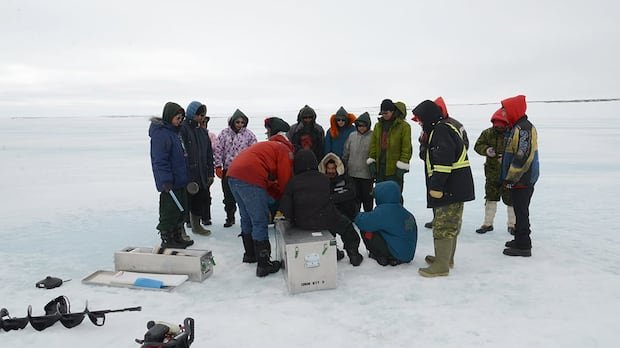
Candice Sudlovenick finds fulfillment in her role as an outreach programs manager at SIKU after being part of Ikaarvik as a youth over ten years ago, an experience she attributes to sparking her interest in research. Reflecting on her time with Ikaarvik, Sudlovenick expressed how empowering it was and how it helped her realize the value of her voice being heard.
A recent publication in Arctic Science, co-authored by Danielle Nowosad, a postdoctoral fellow at the University of Calgary of Métis descent, delves into the topic of Inuit leadership in research methods. Nowosad highlighted Canada’s notable efforts towards incorporating Indigenous perspectives and knowledge.
The genesis of Ikaarvik dates back to 2010 when a group of Inuit youth who had completed the Environmental Technology Program at Nunavut Arctic College in Pond Inlet sought to extend their environmental work beyond the confines of a classroom. The organization’s mission is to equip Inuit youth for careers in bridging traditional Inuit knowledge with scientific research, thereby transforming obstacles into opportunities.
Sudlovenick emphasized the importance of reshaping research relationships with communities, advocating for a broader recognition of Inuit capabilities beyond stereotypical roles. Nowosad underscored the longstanding efforts of Inuit communities to enhance their involvement in research, noting the overlap between Western science and Inuit Qaujimajatuqangit (IQ), traditional knowledge that holds a deep-rooted significance for the Inuit people.
Despite advancements in collaboration, challenges persist in research endeavors. Nowosad pointed out discrepancies between the timelines and objectives of academic institutions and community-based projects, highlighting the need for a harmonious balance between the two. Recognizing the value of deliberate and inclusive community work, some universities and funding bodies are beginning to acknowledge the merits of extended timelines for research projects.
Amidst the rapid changes brought about by climate shifts in the Arctic, the integration of local knowledge is deemed increasingly crucial by researchers and community leaders alike. Sudlovenick stressed the significance of valuing Indigenous knowledge on par with Western science as a means to empower youth in northern regions. The convergence of technological advancements and traditional wisdom among younger generations signals a potential convergence between Western science and Inuit Qaujimajatuqangit in the future.

