
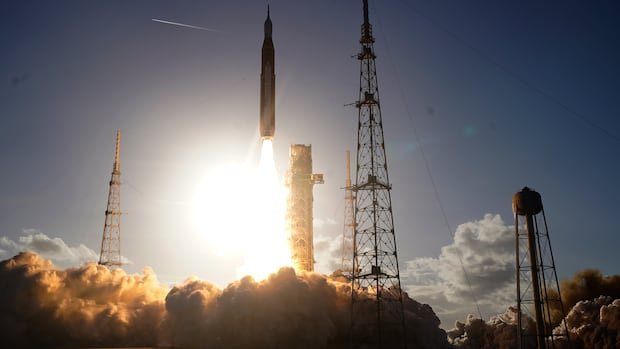
NASA’s Artemis program has garnered attention for its objective to send astronauts around the moon, signaling a broader strategic competition between the United States and China to reintroduce humans to the lunar surface. This contest goes beyond symbolic achievements, focusing on determining prime locations for future lunar infrastructure, setting technical standards, and shaping the next phase of space exploration.
During NASA’s recent Ignition event, officials emphasized the urgency to return Americans to the moon before China, within the timeframe of U.S. President Donald Trump’s tenure. Jared Isaacman, the billionaire chosen by Trump to lead NASA, stressed the significance of this timeline, stating that the success or failure of this mission will be gauged in months rather than years.
Politically, NASA is ramping up efforts to land Americans on the moon by early 2028, while China’s chief designer, Wu Weiren, has projected that Chinese astronauts will reach the moon by 2030. Experts such as Casey Dreier from the Planetary Society question the feasibility of NASA’s 2028 target but acknowledge the strategic value of China’s lunar ambitions in spurring political support.
Unlike the previous U.S. commitment to return to the moon by 2024, which was unmet, analysts observe that China’s steady progress positions them favorably in this ongoing marathon-like space race. Dean Cheng, a space program expert, highlights China’s track record of fulfilling its space ambitions, lending credibility to their 2030 lunar landing goal.
While some argue that the current scenario is not a true race, emphasizing collaboration among space agencies globally, the timeline remains a critical factor. The focus on establishing lunar bases near the moon’s south pole, where valuable resources like water ice are believed to be present, underscores the urgency to secure advantageous sites through early landings.
The push for expedited lunar missions is underscored by the need to establish sustained operations on the moon, setting the stage for future space exploration endeavors. The involvement of private companies, notably SpaceX and Blue Origin, in developing lunar landers adds a layer of complexity to NASA’s funding and operational strategies, highlighting a shift towards private sector collaboration in space missions.
Ultimately, the moon serves as a pivotal intermediary step towards deeper space exploration, with Mars and beyond as the overarching goals for both the U.S. and China. The evolving dynamics of this modern space race underscore a fusion of national objectives, private sector innovation, and international partnerships shaping the future of space exploration.

