
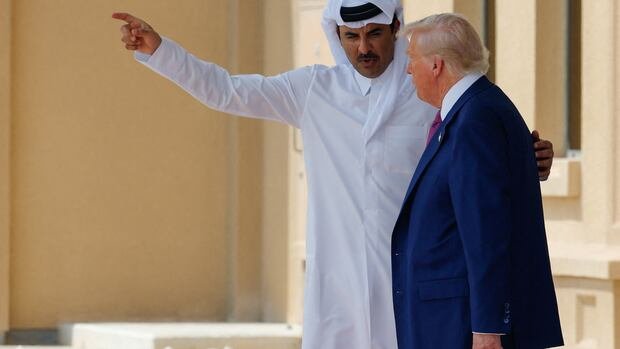
U.S. President Donald Trump has vowed to consider any armed attack on Qatar as a direct threat to the security of the United States. This commitment was outlined in a document released on Wednesday, indicating that U.S. forces could intervene to safeguard the Middle Eastern nation.
Qatar has expressed appreciation for Trump’s directive, hailing it as a significant step in bolstering defense partnerships and bilateral collaboration, as stated by its Foreign Ministry. The issuance of this executive order, which signals a heightened U.S. support for Qatar, follows a recent Israeli airstrike on Hamas leaders in Doha that caught Washington off guard due to the strong U.S.-Qatar alliance, with the country hosting a major U.S. military base in the area.
The order, dated Monday, coincided with Trump’s meeting with Israel’s Prime Minister Benjamin Netanyahu and the presentation of a peace proposal for the Gaza conflict. Qatar has played a crucial role as a mediator between the U.S., Israel, and Hamas during the conflict.
According to the document, in case of an armed attack on Qatar’s territory, sovereignty, or critical infrastructure, the United States will view it as a menace to its own peace and security. The order stipulates that the U.S. will take appropriate measures, including diplomatic, economic, and if necessary, military actions, to protect its interests and those of Qatar, aiming to restore peace and stability.
Criticism arose following the public disclosure of the order. Laura Loomer, a controversial figure known for her provocative online presence, questioned the decision on social media. Similarly, The Wall Street Journal’s editorial board raised concerns about the lack of public debate preceding the executive order.
Saudi Arabia has sought similar security assurances from the U.S. to normalize relations with Israel, although a formal agreement has not materialized. Notably, Saudi Arabia recently signed a defense pact with Pakistan.
While the president can negotiate collective defense treaties, they require Senate approval to become law. Unlike executive orders, which can be overturned by subsequent administrations, the enforceability of the commitment made by the U.S. remains uncertain.
Trump’s order surpasses a 2022 directive by his predecessor Joe Biden, which designated Qatar as a major non-NATO ally, allowing for increased military cooperation but falling short of a defense guarantee in case of an attack.
The Trump administration accepted a luxury Boeing 747 jetliner from Qatar in May, intended for use as a new Air Force One. Secretary of State Marco Rubio confirmed ongoing discussions on an enhanced defense cooperation agreement with Qatar following the Israeli attack.
Overall, Trump’s pledge to defend Qatar signifies a deepening of U.S. commitment to the nation amid regional security challenges.

