
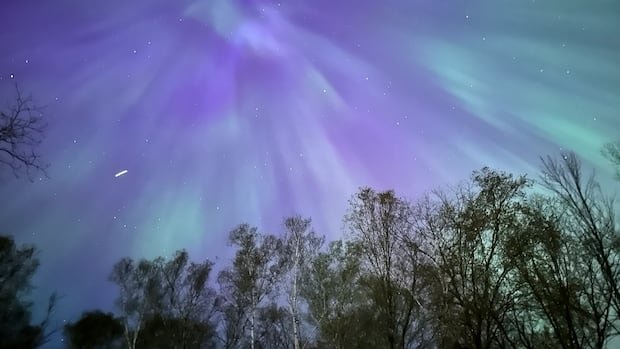
On Monday night, sky gazers with clear skies may be treated to a captivating display of the northern lights. The U.S. Space Weather Prediction Center (SWPC) reported a significant solar event, with the sun unleashing an X 1.9 flare that was accompanied by a prolonged coronal mass ejection (CME). These X flares are the strongest on the solar flare scale, and this particular event stood out as it lasted for an extended period, making it more potent than usual for its magnitude.
CMEs are explosive releases of solar particles that travel swiftly on the solar wind. When Earth intersects their path, these particles interact with the planet’s magnetic field, leading to the creation of the stunning northern lights, also known as the aurora borealis (or aurora australis in the southern hemisphere). Fortunately for aurora enthusiasts, Earth happened to be in the trajectory of the CME.
The SWPC has projected that the CME is expected to reach Earth between late January 19 and early January 20, EST. Geomagnetic storms, disruptions to Earth’s magnetosphere, are categorized from minor (G1) to extreme (G5) on a scale. The SWPC anticipates a severe G4 storm, which is considered significant. Previous G5 storms in May 2024 and October 2024 produced remarkable light displays as far south as the Caribbean.
Typically, the aurora borealis is observed in northern regions, but under specific conditions like Earth intercepting a fast-moving particle stream from a CME, they can be visible further south. For optimal viewing, the auroral hole through which the CME particles travel must dip southward, with visibility extending as the dip deepens. Additionally, the storm should occur during nighttime for optimal viewing conditions.
While this time of year is not ideal due to increased cloud cover, enthusiasts are advised to seek dark-sky locations for the best experience. Given the severity of the forecast, direct north-facing views may not be necessary, though it can enhance the experience if the storm intensity is moderate. Interested individuals can utilize apps like Aurora Alerts and Aurora Forecast to check for aurora borealis visibility in their area.

