
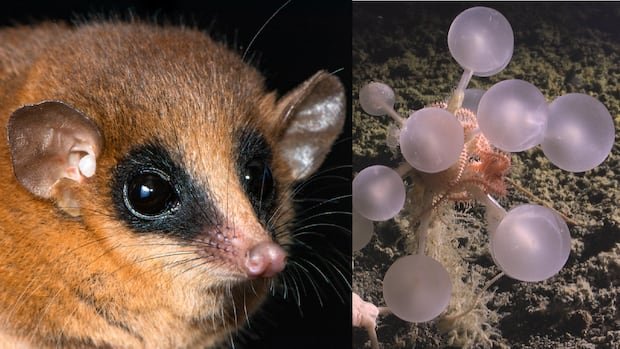
In 2025, the scientific community unveiled several fascinating new species, including a spider boasting elongated genitalia, a carnivorous caterpillar adorned with its prey’s body parts, and a diminutive mountain-dwelling opossum.
A recent study revealed that approximately 16,000 new species are documented annually, with a notable acceleration in this rate. Over the past two decades, 15% of all known species have been newly identified. The lead author of the study, ecology professor John Wiens from the University of Arizona, emphasized that the rapid pace of species discovery surpasses the rate of species extinctions, estimated at around 10 per year.
While many of these new species had been observed locally or captured for museums in the past, they had not been officially classified by science until now. Wiens stressed the importance of officially documenting these species, stating, “We can’t protect a species from extinction if we are unaware of its existence.”
The discovery of new species not only aids in conservation efforts but also unveils intriguing and unique creatures previously unknown to us. Let’s delve into some of these remarkable findings.
### Tarantulas with Remarkable Features
Four new tarantula species were unearthed in the Horn of Africa and Arabian Peninsula, with males exhibiting the longest genitalia ever observed among tarantulas. The largest species, known as Satyrex ferox, boasts a leg-span of 14 centimetres, equivalent to the width of a slice of bread. What sets these tarantulas apart is the males’ palps, measuring a striking five centimetres in length, nearly matching their longest legs. These elongated palps are believed to aid males in maintaining a safe distance during mating to evade aggression from the females.
### Unique Caterpillar Behavior
In Hawaii, scientists discovered a carnivorous caterpillar that resides in spider webs, preys on trapped insects, and crafts a coat or case using their body parts, which later serves as its cocoon. This distinctive “bone collector” caterpillar eventually transforms into a moth with feathery wings. Found exclusively in a small forest region in the Wai’anae mountain range on O’ahu, this caterpillar’s limited habitat suggests it may be vulnerable.
### Fascinating Deep-Sea Species
Explorations in the Southern Ocean near Antarctica led to the identification of 30 new species, including the carnivorous “death-ball” sponge, featuring spheres covered in tiny hooks for trapping prey. Other discoveries included new sea star species and an armored, iridescent scale worm.
### Intriguing Sea Slug Varieties
Shallow waters unveiled intriguing species like the sea slug Phyllidia ovata, resembling a creature adorned with fried eggs. These wart sea slugs, known for preying on sponges and utilizing their toxins for defense, exhibit vibrant colors as a warning to potential predators. Although divers had previously photographed these species in Indonesia, they were officially described by science only recently.
### New Aquatic Discoveries
In Canada, the Okanagan crayfish, distinct from its commonly mistaken counterpart, the signal crayfish, was identified in B.C.’s Okanagan Lake. This new species, lacking the characteristic white mark on the signal crayfish’s claw, is deemed endangered, raising concerns due to human activities in its habitat.
### Unique Bat Species
Canadian researchers contributed to the discovery of six new tube-nosed bat species in the Philippines. These tiny bats, weighing between four to 14 grams, were collected over the past three decades, shedding light on the biodiversity of the region.
### Notable Reptilian Finds
Two reptiles named after famous figures, the long-nosed Pinocchio chameleon from Madagascar and the Lycodon irwini wolf snake from India’s Great Nicobar Island, including a nod to the late Steve Irwin, were among the new species discovered this year.
### Exceptional Amphibians
In the Eastern Arc Mountains of Tanzania, researchers identified three tree-dwelling toads that give birth to live toadlets, bypassing the tadpole stage. Live-bearing frogs and toads are rare, making these new species of particular interest.
Through a combination of physical and genetic analyses of museum specimens, scientists unraveled these intriguing new species, shedding light on the diverse and captivating world of biodiversity.

