
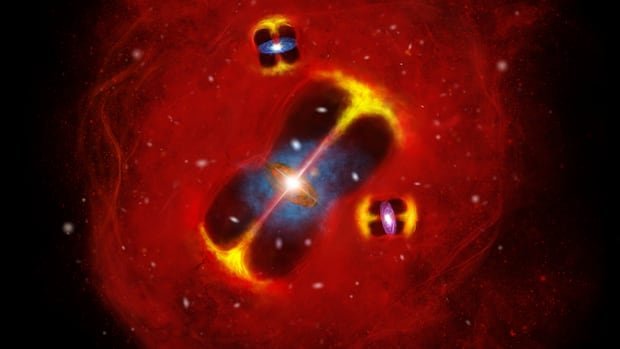
A group of global scientists, led by an astrophysicist from the University of British Columbia, has identified a young galaxy cluster that was generating hot gas at a rate five times higher than previously believed possible. This finding has sparked excitement among astrophysicists, suggesting a potential shift in the understanding of the early universe’s evolution post-Big Bang.
The study, recently published in the Nature journal, involved more than two dozen researchers worldwide investigating the galaxy cluster named SPT2349-56 located approximately 12 billion light years away. Led by UBC PhD candidate Dazhi Zhou, the team observed a substantial amount of hot gas being emitted in the intergalactic space.
Zhou highlighted that this detection of intense hot gas at an early cosmic stage is groundbreaking, given the cluster’s relative youth, forming just 1.4 billion years post-Big Bang. The director of the Dominion Astrophysical Observatory, James Di Francesco, noted that previous assumptions did not anticipate galaxy clusters heating up so rapidly, contrary to the observed phenomenon in this study.
The researchers utilized various telescopes in Chile to explore dark clouds, delve into star formation, and investigate the universe’s earliest moments. By employing radio telescopes to observe short wavelengths, the team could precisely measure the gas’s temperature despite its vast distance from Earth.
Galaxy clusters are assemblies of galaxies, ranging from clusters to superclusters containing hundreds to thousands of galaxies. This research, according to Zhou, is crucial for comprehending contemporary massive galaxy clusters and their formation processes.

