
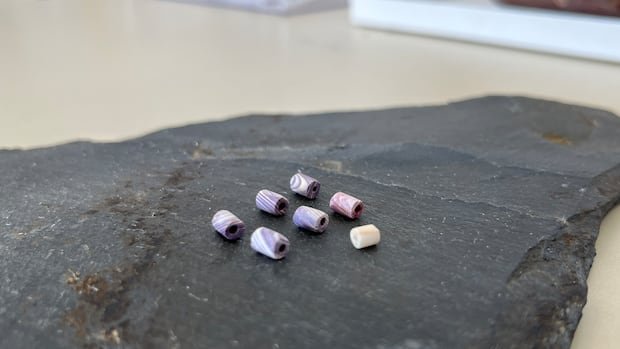
Archaeologists on Newfoundland’s eastern coast made an uncommon discovery this summer by unearthing seven wampum beads, believed to be the first of their kind found in the province. Calum Brydon, an archaeology graduate student from Memorial University, stumbled upon the beads while excavating at the Colony of Avalon in Ferryland, the former residence of early Newfoundland governor Baron George Calvert of Baltimore. The beads, made from quahog and whelk shells, were traditionally used by Indigenous peoples in northeastern North America for ornamental, ceremonial, and trade purposes, as well as for crafting mnemonic belts to record historical events and laws.
The team of archaeologists working in Ferryland speculated that the wampum beads may have been traded by English or Dutch merchants with Indigenous peoples and eventually brought to the Colony of Avalon. Barry Gaulton, a professor of archaeology at Memorial University, highlighted the significance of the discovery in shedding light on life at the 17th-century settlement, initially established as a refuge for Roman Catholics fleeing religious persecution in England.
The Colony of Avalon, known for its well-preserved yet sparsely documented history, has yielded nearly two million artifacts since excavations commenced in 1992. Gaulton emphasized the ongoing discovery of new artifacts, including recent findings such as gaming pieces and structural remains that have enriched the understanding of the colony’s past. Brydon’s discovery of the wampum beads in the cold storage area, along with previously hidden walls, underscored the continuous surprises uncovered at the site.
Gaulton expressed enthusiasm for the exceptional discoveries made this summer, highlighting the insight gained into craft activities and infrastructure at the Colony of Avalon. The unique combination of stone structures and well-preserved artifacts sets this site apart, making it a remarkable archaeological treasure.
Working at the Colony of Avalon has been a rewarding experience for Brydon, who emphasized the rarity and preservation quality of the artifacts found at the site. These discoveries not only enhance historical knowledge but also provide a glimpse into the cultural exchange and trade networks that shaped early settlements in North America.

