
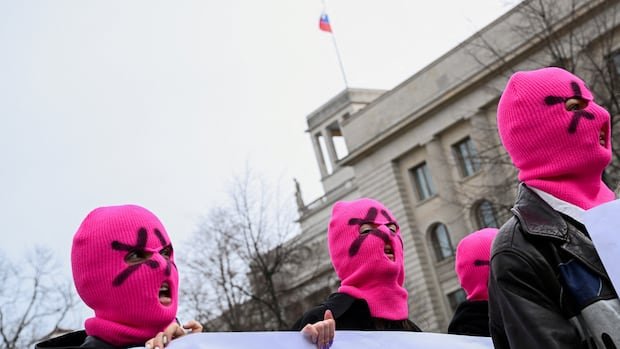
A Moscow court has officially labeled Pussy Riot, the Russian anti-Kremlin feminist punk band and art collective, as an extremist organization, thereby prohibiting its activities within Russia. The decision, disclosed by Moscow’s court service following a closed-door hearing at the request of the General Prosecutor’s Office, comes as part of a broader crackdown on dissenting voices.
The band’s exiled members, known for opposing Moscow’s actions in Ukraine, were recently sentenced in absentia to prison terms of up to 13 years each for allegedly spreading misinformation about the Russian army. Despite being branded as “foreign agents” by authorities, the group has consistently denied the accusations, attributing them to political motives.
This ruling aligns Pussy Riot with other designated organizations like the Jehovah’s Witnesses and the political group of the late opposition figure Alexei Navalny, facilitating potential legal actions against the band’s supporters in Russia and individuals associated with them. Moreover, it may pose challenges for the group’s interactions with Western financial institutions.
Nadya Tolokonnikova, the group’s founder currently residing outside Russia for safety reasons, dismissed the designation, asserting their commitment to truth-telling amid what they perceive as a suppression of dissent. Despite facing criminal charges in Russia, Tolokonnikova remains defiant, criticizing President Vladimir Putin and condemning the court’s attempt to erase Pussy Riot from the Russian consciousness.
The Kremlin, justifying the need for some censorship in the face of perceived external threats, refrains from direct commentary on court rulings, emphasizing the judiciary’s independence. While Putin’s popularity remains high, especially amid the conflict with Ukraine, the Kremlin disregards Pussy Riot and similar groups as fringe activists unrepresentative of mainstream Russian sentiment.
State prosecutors pointed to the band’s past actions, including the controversial Moscow cathedral protest in 2012 and a soccer pitch invasion during the 2018 World Cup, as grounds for branding them extremists. The band’s lawyer defended their actions as ironic and not intended to subvert the constitutional order.

