
Adriana Avelina Ruíz Márquez utilizes false eyelash adhesive to affix a miniature transmitter onto the thorax of a monarch butterfly, positioned just behind its head. Weighing approximately half a gram, the monarch effortlessly carries the 60-milligram device, housing a solar panel comparable in size to a grain of rice. After the delicate procedure, which involves a toothpick and a Q-Tip, Ruíz Márquez releases the butterfly, which promptly takes flight by fluttering its wings.
This novel tracking device, a first-time application in Mexico to tag monarchs before their migration back north to the U.S. and southern Canada, is anticipated to unravel mysteries about these insects. Ruíz Márquez believes that utilizing people’s smartphones will aid in tracking the monarchs’ movements, shedding light on their migration route, activities upon arrival, and departure.
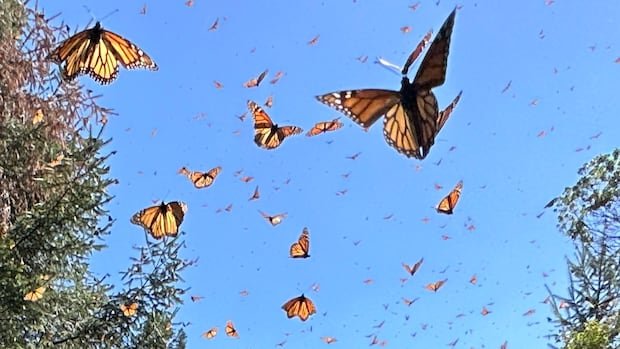
The El Rosario butterfly sanctuary, located in Michoacán, approximately 180 kilometers west of Mexico City, serves as a winter refuge for the vast majority of North America’s monarchs east of the Rocky Mountains. This sanctuary is one of six within the Monarch Butterfly Biosphere Reserve, spanning Michoacán and the State of Mexico, with a central protected area of about 135 square kilometers.
Teams from the federal Commission for National Natural Protected Areas and World Wildlife Fund (WWF) Mexico have tagged a total of 160 monarchs across the reserve, including 40 in El Rosario, with the new transmitters. This initiative aims to provide unprecedented insight into the initial phase of the butterflies’ migration northward, according to Eduardo Rendón Salinas, a biologist with WWF Mexico.
The monarch butterflies typically arrive in November, gradually departing through March. Rendón Salinas emphasized the importance of tagging monarchs at hibernation sites to monitor their activities during their time in Mexico, enabling the tracking of movements between colonies, a previously theoretical concept.
The microchipped transmitter emits a signal detectable by nearby iPhones, enabling crowd-sourcing of the butterflies’ trajectory if Bluetooth and location functions are enabled. This technology, developed by Cellular Tracking Technologies based in New Jersey, offers enhanced spatial detail compared to traditional wing tags, providing a comprehensive understanding of the monarchs’ migration patterns.
Following successful trials in 2023 and 2024, the transmitters were integrated into a continent-wide monarch tracking project involving over 20 groups. By October, 400 monarchs were tagged from Canada to Cuba, with their entry into Mexico’s Monarch Butterfly Biosphere Reserve tracked in November.
The El Rosario sanctuary, guarded by a community patrol to prevent illegal logging, transforms into a haven for the monarchs from November to March. The sanctuary’s diverse ecosystem accommodates various wildlife, with some species adapting to or avoiding interactions with the monarchs and their toxins.
The El Rosario community has established a sustainable tourism industry to coincide with the monarchs’ winter stay, providing crucial income. Moreover, they nurture oyamel seedlings to sustain the forest’s health, reflecting their dedication to preserving the natural wonder that is the monarch butterfly.

