
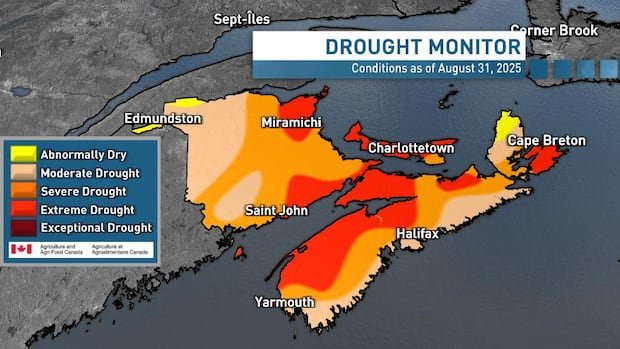
A recent update from the Canadian Drought Monitor reveals significant drought conditions across the Atlantic region, with many areas marked as “extreme drought,” notably Prince Edward Island. The report, released by Agriculture and Agri-Food Canada using data up to August 31, highlights varying drought levels in different parts of the region.
In the Atlantic region, parts of Labrador displayed normal conditions, while areas in Newfoundland ranged from “abnormally dry” to “exceptional drought,” particularly in regions affected by summer forest fires like the Avalon Peninsula. Most of New Brunswick and Nova Scotia experienced drought conditions ranging from “moderate” to “severe.”
The report stated that by the end of the month, 72% of the Atlantic Region faced abnormally dry or moderate to extreme drought conditions, impacting 100% of the region’s agricultural landscape. Regions like New Brunswick, Prince Edward Island, and southwestern Nova Scotia received less than 25% of their average August precipitation.
Furthermore:
– Some parts of the Annapolis Valley recorded their driest August with less than 15 mm of rainfall.
– Charlottetown experienced its third driest August, while Saint John recorded its fourth driest.
– Fredericton, Moncton, and Summerside areas reported their fifth driest August.
The Canadian Drought Monitor highlighted the implementation of fire bans, land use restrictions, and water conservation measures to mitigate the impact of low water conditions. The dry spell led to concerns over water supply, affecting municipalities, residents, and crop yields as irrigation sources dried up.
The lack of rainfall has resulted in dry forests and grasslands across the region, even in typically wet areas like eastern Newfoundland. The situation escalated in Prince Edward Island, where extreme drought conditions rapidly intensified compared to the previous month.
According to the report, Prince Edward Island faced severe drought conditions due to significantly below-average rainfall during the summer months. The region’s meteorologist highlighted that most areas on the island received only half the normal rainfall for June, July, and August, leading to the current severe water scarcity.
In August, rainfall across Prince Edward Island ranged from 10 to 35 millimetres. The Charlottetown Airport recorded just 12 millimetres of rain, far below the normal monthly average of 96.3 millimetres.
Throughout the summer, the Charlottetown Airport received a total of 159 millimetres of rainfall, representing only 60% of the typical amount. Volunteer station data from other parts of the island indicated rainfall levels between 120 and 190 millimetres, well below the normal range of 230-270 millimetres.
The meteorologist emphasized that summer rainfall in the region is often localized and sporadic, with convective thunderstorms impacting specific areas. This data does not fully capture the rainfall distribution across Prince Edward Island.

